Alumni News

‘It’s never too late to turn things around’: Oscar-nominated alum Delroy Lindo visits SFSU to talk with students

Intimate conversations with formerly incarcerated students and foster youth give them motivation 

The Academy Award-nominated actor Delroy Lindo spent May 8 at San Francisco State University, returning to the place where he earned his bachelor’s degree in Cinema. He came to meet — and inspire — our students of today. 

In intimate sessions with about 30 students and alumni in the Project Rebound and Guardian Scholars programs, Lindo engaged in emotional back-and-forth conversations with students. Rather than deliver lectures, he sat down in the front of the classroom and asked the students about their lived experiences and answered their questions.   

Project Rebound, a program of Associated Students, provides admissions and academic support for formerly incarcerated people. The Guardian Scholars Program helps students who have been in the foster-care system, offering them guaranteed admission to the University and supporting them throughout their SFSU career.   

“Programs like this are what make San Francisco State special: the concerted effort to reach out to communities that might not ordinarily have the opportunity to get a college education,” said Lindo, a member of the SFSU Foundation Board of Directors.  

Lindo has appeared in dozens of films, television shows and on the stage since the 1970s. He earned his first Academy Award nomination and Actor Award this year for Best Supporting Actor in “Sinners.” Born in England, he struggled through a disadvantaged childhood.  

“I am a walking, talking manifestation of ‘It’s never too late to turn things around.’ It’s never too late. I have lived that,” Lindo (B.A., ’04) told the Guardian Scholars. “What enabled me to be sitting here today talking to you all is that I had this dream. From the time I was young, when I grew up, I wanted to be an actor. Having that as my North Star gave me something to hold on to. Now, I’m saying this to you not because I’m proud. I’m saying this to you to communicate that there is always an ultimate path that you can take.” 

Our SFSU students say they found their conversations with Lindo to be highly valuable and inspirational. 

“I feel like it’s important for us to have opportunities like this, so that we can see for ourselves that our adverse background doesn’t discriminate us from opportunities,” said Sherrell Monique Teague, a graduating senior with a double major in Theatre Arts and Public Health. “Being able to have this opportunity makes me feel like, ‘OK, I can do this. I can keep going.’” 

Lindo is scheduled to speak to many more of our Gators this month. At the University’s Commencement ceremony on May 21, he will receive an honorary Doctor of Fine Arts degree and deliver the keynote address.   

Learn more about SFSU’s School of Cinema. 

Delroy Lindo embraces several students while they smile and stand in the hallway of the SFSU Science and Engineering Innovation Center
Project Rebound students pose for a group photo with Delroy Lindo in the hallway of the SFSU Science and Engineering Innovation Center
Guardian Scholars Program students pose for a group photo with Delroy Lindo in the hallway of the SFSU Science and Engineering Innovation Center

SFSU teams up with the Giants for annual alumni night at the ballpark

Dozens of alumni, students bring their Gator purple and gold to Major League Baseball  

The Gators of San Francisco State University took over the home of the San Francisco Giants on April 7 for alumni night. Dozens of SFSU alumni and students gathered to attend the 10th annual San Francisco State University Night at a Major League Baseball game between the Giants and the Philadelphia Phillies at Oracle Park. 

The crowd could feel the SFSU presence beyond the many fans dressed in their best Gator purple and gold. The pre-game festivities included 2025 SFSU Alumni Hall of Fame inductee Ghazi Shami throwing out the ceremonial first pitch and the daughter of fellow Alumni Hall of Famer Evan Kidera yelling out, “Play ball!” Gators volleyball star Kimberly DeBoer, a 2025 NCAA Women of the Year Top 30 Honoree, was interviewed on the field. SFSU’s mascot, Alli Gator, shimmied and danced alongside their Giants counterpart in costume, Lou Seal. 

Fans coming for the SFSU Night purchased tickets at a 30% discount and received a special roped hat bearing logos of both the Giants and the Gators.  

SFSU Night is not the only time the Gators take over Oracle Park. We also host our annual Commencement ceremony at the world-class ballpark, honoring all of our world-class Gator graduates. This year’s Commencement is scheduled for Thursday, May 21. 

Learn more about the SFSU Alumni Association. 

Three people smile while seated at Oracle Park
Two people pose for a photo while seated in the bleachers of Oracle Park with one of them flashing a peace sign and the other holding a co-branded SFSU/San Francisco Giants baseball cap
A group of seven people smiling while seated at Oracle Park wearing co-branded SFSU/San Francisco Giants baseball caps

SFSU grad lands Grammy nod for Album of the Year as a mastering engineer

Zach Pereyra (B.A., ’17) puts finishing touches on latest Clipse album 

Studies have shown that one must practice for 10,000 hours to master their craft. Zach Pereyra completed a lofty number of his hours at San Francisco State University before earning his first Grammy Award nomination this year.   

Pereyra’s Grammy nomination came in the Album of the Year category as the mastering engineer for “Let God Sort Em Out,” performed by the Clipse with production by Pharrell Williams.  

Pereyra (B.A., ’17) credits SFSU’s Broadcast and Electronic Communication Arts (BECA) Department for helping him discover his career path. He found a home in the campus music recording studio that was helmed by Professor John Barsotti beginning in 1973. Barsotti, a respected audio engineer, became a mentor to Pereyra.   

“He had all these old two-track, four-track, eight-track tapes,” Pereyra said. “One semester, I did an independent study program with him. I would refurbish some of the tapes a little bit, and then I would transfer his old recordings from the 1970s and 1980s, to archive them digitally. 

“I didn’t know it then, but the reel-to-reel tape machine that we had is one of the gold standards when it comes to mastering music,” he added. “There have been times within the last couple years when I’ve had to use that type of tape machine.” 

When Pereyra wasn’t in the studio, he could often be found at the student-run radio station, KSFS. He and his friends had a show where they improvised to make beats live on air. Pereyra also broadened his horizons by taking electives in areas such as Music and Cinema. While taking a Journalism class, he met his future wife, Mackenzie Guthrie (B.A., ’17), now a marketing and communications specialist.

As a mastering engineer, Pereyra begins his work after the music is recorded and mixed. He makes final adjustments to all sonic components, including enhancing tracks to taste and the sequencing of albums. 

“I’m the last set of ears to come in and be an objective listener,” he said. “It is my goal to ensure that the emotion of a record is achieving what the intention is supposed to be. It’s inherently musical and sometimes technical, but also, I find sometimes there’s some psychology to it. We’re so close to the finish line, and it’s my job to make everybody feel like we’re done and ready to go.” 

Pereyra grew up in the Los Angeles area and entered SFSU as a Gators baseball recruit. His first-ever trip to 19th and Holloway came, however, when he was 9 or 10 years old, to visit an older sister living in an SFSU residence hall. “I knew that if I could make it work, I would go there,” he said.  

Pereyra now works out of the storied Larrabee Studios in North Hollywood, founded by Carole King and Gerry Goffin. He was relentless about getting his foot in the door at Larrabee once he and Guthrie moved to Southern California three years after SFSU. 

“I kept calling until I got an interview to be a studio runner, taking food orders, taking out the trash, cleaning the bathrooms and stuff,” he said.   

It’s safe to say Pereyra has far exceeded his 10,000 hours of training. He has mastered more than 1,000 songs, garnering 45 billion streams worldwide. His upcoming projects include albums from Charlie Puth and Lizzo.  

Pereyra and Guthrie reflect upon their SFSU years often. 

“Oh, man, I loved it. It was the coolest,” he said. “I remember vividly experiences in the Creative Arts building, working on projects, hearing music and then walking outside and there’s a demonstration or protest. Passion and creativity all over.”  

Learn more about the Broadcast and Electronic Communication Arts Department. 

Zach Pereyra and Mackenzie Guthrie pose for a photo on the red carpet of the 2026 Grammy Awards

Photo courtesy of Zach Pereyra

SFSU to honor Japanese American students who faced discrimination in World War II

Ceremony on Feb. 19 will take place in Ruth Asawa Garden of Remembrance on campus 

WHAT: San Francisco State University commemorates the annual Day of Remembrance, recognizing the unlawful incarceration of Japanese Americans during World War War II, with a special event, free and open to the public. Event organizers invite attendees to reflect on contemporary experiences of racialized violence and xenophobia.  

The event will feature an exhibition of the Wakasa Spirit Stone, a screening of the short film “DUST” by Glenn Mitsui and Brandon Shimoda and a ceremony honoring the 19 Japanese American SFSU students forced to withdraw from their classes during World War II and taken to barbed-wire prison camps. The film begins at 5:30 p.m. in Burk Hall room 28, followed by an outdoor ceremony in the Ruth Asawa Garden of Remembrance. Several children of the original students will attend, with one of them slated to perform a musical piece. 

Dedicated in 2002, the Garden of Remembrance is artist Ruth Asawa’s final installation, located between Burk Hall and the Fine Arts building on the main SFSU campus. A cascading waterfall signifies the return of the incarcerated people to the coastline after the war. Ten large boulders represent each of the camps set up during World War II. The names of the SFSU students and the names of the camps are listed on a bronze, scroll-shaped marker. The marker also includes reproductions of official government documents regarding the incarceration.  

WHO: San Francisco State University’s Edison Uno Initiative for Nikkei and Uchinaanchu Studies and Asian American Studies Department, including Professor Cassie Miura and other community members. 

WHEN: Thursday, Feb. 19, 5:30 – 7 p.m. 

WHERE: Burk Hall room 28 and the Garden of Remembrance, San Francisco State University, 1600 Holloway Ave., San Francisco 

HOW: For more information and to RSVP, visit the SFSU event page.

‘The Future of the Ramaytush Ohlone’: SFSU alum designs posters for San Francisco bus shelters

Works by Marcelo Potosí honor the Indigenous peoples of the San Francisco Peninsula 

Two years ago while attending San Francisco State University, Marcelo Potosí was reading an email from one of his instructors about an opportunity from the San Francisco Arts Commission and decided to apply. Now he is one of four artists featured in the commission’s Art on Market Poster Series devoted to the original peoples of the San Francisco Bay Area. 

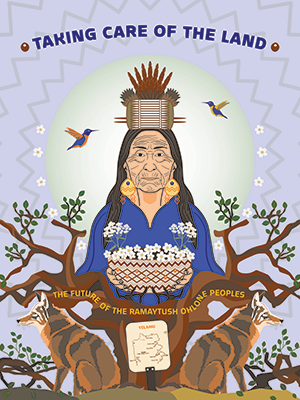
Potosí’s six posters, titled “The Future of the Ramaytush Ohlone,” are on display at 15 Muni bus shelters on Market Street between Seventh and Steuart streets through Friday, Feb. 28. Each poster centers a figure against a backdrop that depicts historical and cultural locations in San Francisco, enhanced with native plants and animals. The designs also include silhouettes inspired by historical paintings of the Ramaytush Ohlone, accompanied by text reflecting the Indigenous tribe’s cultural values and aspirations. The Ramaytush Ohlone tribe comprises the Native peoples of the San Francisco Peninsula. 

“Marcelo Potosí’s artwork beautifully and masterfully intertwines the rich cultural history of the Ramaytush Ohlone with visionary ideals for the future,” said Ralph Remington, director of cultural affairs for the San Francisco Arts Commission. “Through his striking poster designs, Potosí honors the deep-rooted legacy of the Ohlone peoples, while urging us to envision and reimagine a future grounded in respect for the land, its original stewards and the environment.” 

Potosí says he finds the Ramaytush Ohlone have much in common with his own Indigenous roots. He is a Kichwa-Otavalo person from Ecuador. 

“They are dedicated to giving back to the land and protecting it from pollution. This is also something we honor back in Ecuador,” said Potosí (B.A., ’24), who works as a freelance graphic designer. “By creating this poster series, I was trying to show the goals that the Ramaytush Ohlone have, and also just to let people know who the original peoples of this land were.” 

At age 15 in 1991, Potosí and his late father, a merchant who visited the U.S. frequently, arrived in New York City. After six months living and working there, Potosí moved to San Francisco with a one-way cross-country ticket on Greyhound. He hasn’t moved from San Francisco since. 

At the time he still was beginning to learn English, working his way through a wide range of customer service and office jobs. He earned an associate’s degree from City College of San Francisco in 2003 but didn’t enter SFSU until 2021. 

He immersed himself in the University’s School of Art, gaining a great deal of valuable skills and knowledge in printmaking, drawing, exhibition design and art history. “Every class was amazing,” he said.  

A class in Latin American art history was particularly inspirational. 

“That class was also really valuable because we went over art from Mexico and South America, and it introduced me to artists that are from South America,” he said. “By looking at their art I felt very connected to my roots and made me explore more about what South American art means. It motivated me to explore more art produced by Indigenous people and their beliefs and their connection with the Earth.” 
Learn more about the SFSU School of Art. 

Marcelo Potosí's poster Taking Care of the Land for the series The Future of the Ramaytush Ohlone Peoples

Image credit: courtesy of the San Francisco Arts Commission
‘A magical experience’: SFSU alumni share their greatest Gator memories

For 125 years, a ‘harmonic convergence’ at SF State has brought together students of many backgrounds for education, justice and social mobility 

For countless Gator alumni, San Francisco State University has provided them with some of their most vivid memories: the crushes, the “aha” moments, the life-changing lectures, labs and professors. 

As San Francisco State celebrates its 125th anniversary this year, the University put out a call to alumni to share their greatest memories on campus. We also take a look back at notable quotes by alumni over the years in SF State Magazine and the 1999 Centennial magazine, published for the University’s 100th anniversary. 

Willie L. Brown Jr. (B.A., ’55), former mayor of San Francisco 

By my sophomore year I was already heavily involved in politicking, getting students elected to student government. Also, I lived in housing that the school rented in Potrero Hill. I paid $14 a month rent, but the food program we had to organize ourselves. We had a treasurer, a secretary, someone responsible for buying the food. We ran our complex. 

Laureen Chew (B.A., ’70; M.A., ’72), professor emerita of Asian American Studies 

[The Third World Liberation Front student strike of 1968 and 1969] was an impassioned plea for change. It altered my life completely, not just as a student, but as a person. We felt we had to go on strike; we had no other choice.

Linda Yelnick (B.A., ’70), music booking agent 

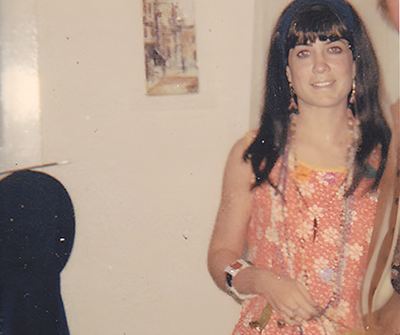
I really had fun attending SF State during the year of the Summer of Love, 1967, and the late ’60s. Now so many years later, I am still and always will be this “flower child” on the inside, and I wish peace and love to everyone. I have always been so honored and proud to have been a student there during its tumultuous late ’60s and now as an alumna. GGF Go Gators Forever :). 

Dan Gonzales (B.A., ’74), professor emeritus of Asian American Studies 

I don’t know what it is about SF State. [During the strike], there was a harmonic convergence — there were a lot of really interesting people that just happened to coincide on the campus, on both sides, and [the strike] probably wouldn’t have happened at any other time or with a different group of people. 

A photo from the 1960s shows Linda Yelnick standing indoors in front of a chair wearing a dress, beaded necklaces and a beaded bracelet while holding a yellow bag and a floral-designed bag

Courtesy of Linda Yelnick

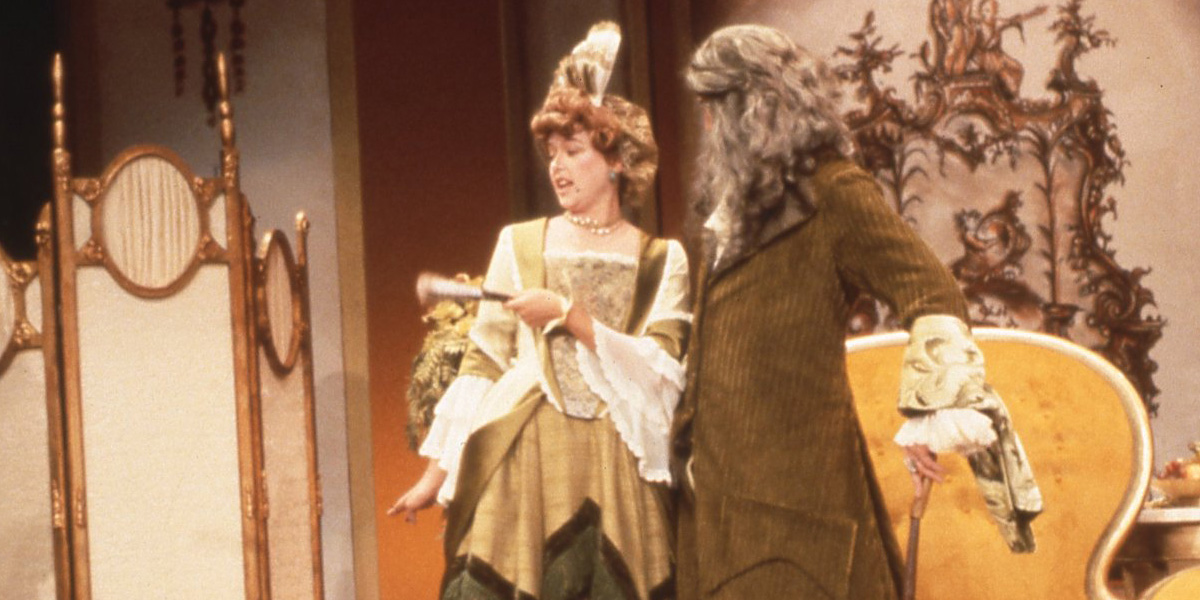
An archival photo shows Annette Bening and another actor on stage in period costumes performing in a student production at SFSU in the 1970s

Courtesy of Annette Bening

Annette Bening (B.A., ’80), Academy Award-nominated actress 

I knew I loved acting, but at San Francisco State, I got the chance to develop that love. I am so grateful for the safe, challenging environment I had in which to educate myself, develop my aspirations and, most importantly, a place where I could practice and learn how to trust and value my own individual creative instincts. 

Dan Button (B.S., ’83), high school teacher 

In the spring of 1982, I saw a girl walk her bike across campus to the student union. ... I found out she worked at a snack bar in the basement, but I was kind of shy, so I got in line and ordered a bagel just to get the chance to talk to her. ... Finally, I found the nerve to ask her out and, unbelievably, she said yes. Three months later, on a beach in Mexico, I asked Jamie to marry me. We were married two years later. I received more than an outstanding education at State. I also got the woman of my dreams, the mother of my children and my best friend.  

Rina Ayuyang (B.A., ’98), comics artist 

I lived near campus and would walk down the halls a lot. ... I remember one evening I stumbled upon this one event that was happening in the Creative Arts building. It was a smaller event room. There was this Filipino ensemble playing “Dahil Sayo (Because of You),” which is a Filipino ballad. It was a very film-noir scene actually, this woman singing this Filipino romantic ballad that I just came and found myself in. And it was a very magical experience. 

Chinomnso Okorie stands with her hands in her pants pockets on a hilltop in San Francisco on a sunny day with the Hunters Point Naval Shipyard, the San Francisco Bay and the East Bay hills in the background

Photo of Chinomnso Okorie by Deanne Fitzmaurice

Chinomnso Okorie (B.S., ’17; M.S., ’19), data scientist 

[Volunteering at the SFSU Women’s Center], I became so hyperaware of the fact that Black women suffered the most disparities in terms of birth outcomes. I slowly started to fall in love with reproductive health because nobody talks about these things. I was like, “Oh my gosh — I found my niche!” 

Join the SFSU Alumni Association. 

SFSU alum writes book about his grandfather’s resistance against Nazism

‘Postcards to Hitler’ author Bruce Neuburger is inspired by his brave, defiant grandfather  

As a former farmworker, cab driver and teacher, Bruce Neuburger has seen a lot. But it is nothing compared to what his grandfather experienced in the Holocaust. It is told in Neuburger’s new book, “Postcards to Hitler: A German Jew’s Defiance in a Time of Terror” (Monthly Review Press/NYU Press). 

During the Nazi regime, Neuburger’s grandfather, a German land investor, distributed anonymous postcards to his neighbors to warn them of Adolf Hitler, only to be arrested by the Gestapo and subjected to a sham trial and brutal murder. 

At San Francisco State University, Neuberger (B.A., ’86; M.A., ’95) was a triple major in History, Spanish and La Raza Studies (now Latina/Latino Studies). He is now retired from teaching English as a second language at City College of San Francisco and adult schools.

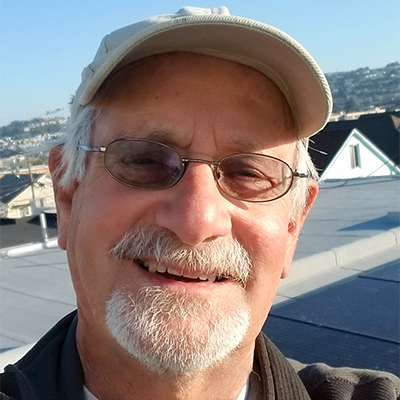
Bruce Neuberger selfie taken on the roof of his home in San Francisco on a sunny day

At what age did you learn about your grandfather, Benno Neuburger? 

I was fairly young at the time. My father would tell me about his father, but very little. He would say that his father was tried in the People’s Court. He used to say “the so-called ‘People’”— which is true — and he was executed. But the way my father characterized it to me was that his father had sent a personal letter to Hitler, denouncing him for what he was doing to Jews and saying he’s always been a loyal German citizen. ... I didn’t find out until after my father had passed away what actually happened. And he never knew about the postcards. 

If you had the opportunity to meet Benno today, what would you say to him? 

I would say congratulations. And I would tell him that after all these years his acts of resistance are remembered as a positive example of standing up to injustice. And, ironically, so many years later, resistance to injustice and fascism is still relevant today! 

What are the most profound things that you learned from researching and writing “Postcards to Hitler”?  

I think the most profound thing, frankly, is the connection between the rise of fascism and World War I. Defeat in World War I was the catalyst for fascism in Germany.

Why did you decide to attend San Francisco State? 

I liked the atmosphere here. To be honest with you, I was fearful of coming back to school. I was already in my 40s and I thought, I’m going to feel like a fish out of water here. It’s going to be all these young people, and I’m going to be this old guy. But I came back here; it wasn’t true. There were a lot of older folks like me in their 40s and beyond that, so I felt comfortable. 

Can you recall a moment as a student at San Francisco State that had a significant impact on your life? 

I had some really good teachers. Did you know about Professor [Isidro] Mauleón? At the end of the class, he would invite the students to come and have a meal at a Basque restaurant down on Broadway. We’d have these elaborate meals for hours.  

So I remember that meal. I don’t remember too many meals in my life. I remember that one. 

Learn more about SFSU’s History Department, Spanish Program and College of Ethnic Studies


German-language video about ‘Postcards to Hitler’

SF State graduate founded America’s longest-running Juneteenth celebration

Wesley Johnson was a 1930s student activist before becoming a seminal entrepreneur in San Francisco’s Fillmore District

For the second time ever, the San Francisco State University campus will close on June 19 for Juneteenth. The festivities in San Francisco for the new federal holiday — which commemorates the emancipation of African American enslaved persons — have been rededicated to their founder, a San Francisco State alumnus named Wesley Johnson.  

In 1945, Johnson created what would become the longest continuously running Juneteenth celebration in America. The native Texan announced it in grandiose fashion, riding a white stallion in the street and inviting passersby to celebrate at his Fillmore District nightclub. Nineteen years later, he established the Juneteenth parade in San Francisco, leading the way again on a white horse in his signature 10-gallon white Stetson cowboy hat to set off a three-day festival. This year the parade took place on June 8, alongside a month filled with festivals in several neighborhoods. 

SF State alumna Melina Jones, who has served on the committee for the Juneteenth parade and festival, learned about Johnson when researching the history of the holiday for her annual “BlaCOEUR” Juneteenth event. 

“I just got so excited about him and his legacy in the Fillmore during the Harlem of the West era of the ’40s and ’50s,” said Jones, a designer and rap artist born and raised in San Francisco. “I was incredibly proud just to be from here and to know that I get to be from a region where there are all of these innovators who are just brilliant cultural engineers.” 

Wesley Johnson was born in 1908 in Galveston, Texas — the same city where Juneteenth celebrations began on June 19, 1866, one year after a Union Army general issued an order informing Texans that enslaved persons were now free. Although President Abraham Lincoln signed the Emancipation Proclamation on Jan. 1, 1863, it took two and a half years for the news to spread and for abolition to be enforced. 

After World War I, when Johnson was still a teenager, he and his family moved to San Francisco. Due to racist housing covenants and redlining, African Americans were welcome to live in only three of the city’s neighborhoods; the Johnson family settled in the Fillmore District. He entered San Francisco State College when the campus was located on Haight Street with about 1,100 students, very few of them Black.  

Several archival news clippings from the Golden Gater student newspaper, available in the University Archives in the J. Paul Leonard Library, highlight Johnson’s engagement in student life. In fall 1931, pledges from the Delta Sigma Theta sorority threw him a party to celebrate the birth of his second son. “Oh yes, all I need now is three more and I will have a basketball team!” Johnson quipped. 

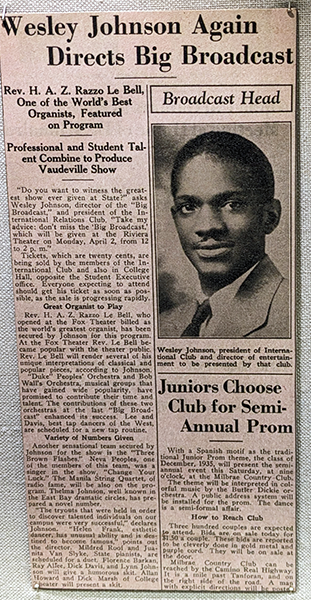
As president of the International Relations Club, Johnson directed “The Big Broadcast,” a live variety show on campus in the 1930s. Tickets were 20 cents each. “Do you want to witness the greatest show ever given at State?” Johnson said in the Golden Gater to promote the show. 

SF State Associate Librarian Meredith Eliassen, the University’s archivist, notes that Johnson launched one of the first student organizations for African Americans. In 1935 he created the Utopian Club for African Americans to discuss social issues. The following year it became the Negro Students Club, which would eventually be replaced by the first-ever Black Student Union

Eliassen says Johnson paved the way for students who decades later organized efforts to effect change, particularly the strike of 1968 – 1969 that resulted in the nation’s first College of Ethnic Studies

“The issues for Black students in the ’30s were the same as the ’60s: They were paying a fee, but not getting an equal education,” Eliassen said, noting students were unhappy about exclusionary admissions policies and curricula that omitted persons of color. 

After graduating from SF State, Johnson became one of the seminal entrepreneurs in the Fillmore District, as detailed in a Western Historical Quarterly article by Emily Blanck from 2019. The commercial corridor of Fillmore Street was thriving with African American-owned businesses, giving the area its status as the “Harlem of the West.” Among the area’s 20 nightclubs were Johnson’s Texas Playhouse (also known as Club Flamingo, with 15 hotel rooms above the ground floor) and the Congo. On any given night Johnson would be spinning jazz music and dancing “up and down the bar,” waitress Dorothy Alley said in the 2006 book “Harlem of the West: The San Francisco Fillmore Jazz Era” by Elizabeth Pepin (B.A., ’94) and Lewis Watts. Famous musicians like Billie Holliday and Louis Armstrong would visit and spend time with Johnson. 

Johnson retired as grand marshal of the Juneteenth parade in the late 1980s. His legacy continues to grow, as people like Jones seek to share his story and his values with younger generations, with the aim to inspire as many as possible. She designed a new website and logo for Juneteenth in San Francisco. Unveiled just last month, the logo depicts a silhouette of Johnson on a white horse. Jones also wrote an article about Johnson for the Juneteenth San Francisco website

“When he had these businesses, he looked incredibly impeccable. Everybody came with this allure and this air of excellence and pride — and he would not have it any other way,” Jones said. “You could see that he had this very unwavering desire to be excellent, and you could see it in all the pictures. I think he was extremely strategic and just very proud.” 

Visit the University Archives in the J. Paul Leonard Library

Golden Gator archival news clipping behind a display case with the headline Wesley Johnson Again Directs Big Broadcast

An archival news clipping from the Golden Gater, as seen on display in the J. Paul Leonard Library

Debut novel by SF State alum shows the comfort of surviving in nature

Charlie J. Stephens’ ‘A Wounded Deer Leaps Highest’ follows a nonbinary child escaping danger into the refuge of the woods 

The debut novel from San Francisco State University graduate Charlie J. Stephens shows how the grace of nature can be an oasis of solace in times of strife. “A Wounded Deer Leaps Highest” follows a nonbinary child, Smokey, in Oregon in the 1980s. As their mother’s boyfriends come and go, Smokey aches for the comfort and safety their mother can never quite provide. When a dangerous new man moves in, Smokey finds refuge in the forests, giving themselves over to the strength and beauty of the environment. 

Stephens (M.A., ’09) has worked as a bike messenger, shark diver, wilderness guide, high school English teacher and more. After moving back to their home state of Oregon, they opened Sea Wolf Books & Community Writing Center by the coast in Port Orford. 

Stephens recently took the time to answer questions from SF State News during their recent writing residency in Palmer, Alaska, thanks to Pam Houston’s nonprofit organization, Writing by Writers. 

What inspired you to make “A Wounded Deer Leaps Highest” into your debut novel? 

The novel developed from a short story that I worked on for about eight years. It was kind of a strange experience/process because even though I worked on it for so much time, it never really got longer, just more developed and solid-feeling. When it eventually got published in a literary journal, I thought that would be the end of that piece. But because I spent so much time on it and knew those characters so well, developing the story into a full novel wasn’t that much of a stretch, and I found myself wanting to keep going with it. The result is “A Wounded Deer Leaps Highest,” which was published by Torrey House Press in April of this year. 

How closely is the story and the main character, Smokey, based on you and your life?   

The novel is a work of fiction (only about 5 – 10% from my own life experiences — the main one being that I grew up in Oregon in the ’80s and early ’90s) but I always consider it a compliment when people think it’s autobiographical. I hope that means that the story feels believable, personal and emotionally compelling to the reader in some way. 

How did you discover the healing powers of nature?  

I’ve always been connected to nature, having grown up in the Pacific Northwest and with a family who really appreciated the outdoors, plants and animals, being outside and trying to be good stewards for our land and waterways. Growing up working class in particular was part of this connection, as the plants and animals around me were always present, accessible and delightful — regardless of the houses we lived in or how much money we had. 

You mentioned the book “deals with queerness in a complex way.” Please explain more about this approach and why you chose it.  

This is a difficult time we are experiencing as humans (and animals) on almost every level. Queer people, trans people and nonbinary people are being strategically targeted on national, state and local levels. With the rise of book banning, textbook overhaul, the attack on public libraries, not being able to even say the word “gay” in many school districts and the criminalization of children and their families seeking gender-affirming care, it feels both vulnerable (for me as the gender non-conforming author of this novel) and critically important to show a nonbinary child in literature, in both beautiful ways as well as in showing some of the forces that don't really want that child (or others like them) to exist or thrive. 

Why did you choose San Francisco State for graduate school?  

I chose SF State because of its accessibility and its commitment to social justice throughout many of its programs, as well as for its campus diversity as a whole. I received my Master of Arts in Equity and Social Justice Education. 

Can you describe a pivotal moment at San Francisco State that changed or impacted your life?  

Being in a classroom with Jeff Duncan-Andrade was the most meaningful aspect of my time at SF State. His radical thinking, personal presence, compassion and commitment to youth and the adults who work with them was deeply profound, and the effects of his teaching have been long-lasting. 

Tell us about Sea Wolf Books & Community Writing Center: Why did you decide to establish this? 

After teaching in different capacities for most of my life — most recently as a high school English teacher — I needed a change after the pandemic. I decided to leave the Bay Area for the Oregon Coast and wanted to do something that I thought would benefit my newfound community. With my love for literature and my commitment to teaching, opening up a bookstore and writing center seemed like it would serve a need and also be something personally fulfilling, fun and engaging. It has been all that and more, and I’m incredibly grateful for it. 

What do you want to be known for?  

I’d like to be known as a writer, teacher and human who was brave enough to be publicly vulnerable, thoughtful and honest in this overwhelming world we find ourselves inhabiting.  

Learn more about the SF State Graduate College of Education

Student’s documentary helps her family heal from intergenerational trauma

Cecilia Mellieon and her daughter sit outdoors at Fortaleza Indian Ruins, homeland of their ancestors, near the Tohono O’odham Nation’s San Lucy Village outside of Gila Bend, Arizona. Photo from 2001.

Grad student Cecilia Mellieon utilizes visual anthropology, a field of study founded at SF State, to tell stories of urban Native American life 

With a video camera in her hands and empathy in her heart, one San Francisco State University student is focusing her capstone project on a subject many families prefer to avoid: their intergenerational trauma.  

Cecilia Mellieon, a graduate student in Anthropology at San Francisco State, is the director of a documentary titled “He told us the sky is blue.” It traces her family’s trauma to Native American oppression, focusing on the Indian boarding school her father attended in Fort Apache, Arizona.  

“If it hadn’t been for his experience there, he would have never left his family or his village,” said Mellieon, a member of the Tohono O’odham Nation. “He would have never moved to the Bay Area, and so I would not even be here if it wasn’t for him making those decisions to get away from them.” 

The U.S. government established the boarding schools to teach English and trade skills to Native American children. Violent corporal punishment occurred often.  

“The ultimate goal was to have fully assimilated second-generation children — children who were removed from their lands, children who didn’t grow up with their culture or their language or their family members,” Mellieon said. 

In her 55-minute film, Mellieon’s family recalls surviving an abusive household. They share feelings of sadness and regret as they also work to resolve their anger. 

“These are stories that I know too well, because I was there,” Mellieon said. “There are scenes where my brother and my mom are breaking down crying. I was crying with them.” 

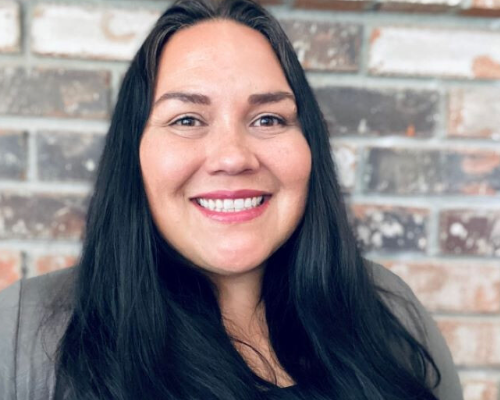
Cecilia Mellieon headshot

Born and raised in San Francisco, Mellieon is passionate about telling stories of urban Native American life with nuance and sensitivity. She uses a supportive, collaborative approach that aims to not only create an ethnography, but also a work that will benefit the subjects. 

Her approach is an application of visual anthropology, a field of study that was founded by late SF State faculty members John Adair and John Collier. SF State Anthropology Professor Peter Biella (B.A., ’72; M.A., ’75) was one of Collier’s students, and today he is Mellieon’s adviser. 

Mellieon entered SF State as an undergraduate in 2018 at age 42. She had just completed her associate’s degree from Los Medanos College while her third child had yet to start kindergarten.  

A new Bay Area Rapid Transit (BART) extension to near her home in Antioch made the 50-mile commute to SF State feasible, with family help on child care. Now, one of her children, Tatihn Mellieon, also attends SF State, as a Creative Writing major and a student assistant in The Poetry Center. 

“It was the perfect grouping of coincidences that led to me to be able to go to State,” Cecilia Mellieon said. “If I had tried this at any other point in my life, I don’t think I would have had the life experiences. I don’t think I would have had the growth that I needed to be a confident student and be able to feel like I could tackle this.” 

Mellieon premiered “He told us the sky is blue” in November at Los Medanos College. She plans to take it to film festivals and make more anthropological films about big-city Indigenous life. 

Learn more about the Anthropology Department