Biology

Leticia Márquez-Magaña named a 2023 American Association for the Advancement of Science Fellow

The SF State Biology professor is being honored for bacterial research into gene expression and health equity

For San Francisco State University Professor of Biology Leticia Márquez-Magaña, it’s all about community. Her health equity research, educational efforts and prominence as a public figure in the scientific community — none of it’s about her at this stage in her career.

“It’s all about the little Leticias. They need to see what is possible in order to be what they usually don’t see,” she explained. This community mentality was instilled in her at a young age by her family and Mexican culture.

Today, Márquez-Magaña has been recognized as a Fellow of the American Association for the Advancement of Science (AAAS), the world’s largest general scientific society and publisher of the Science family of journals. She is among 502 scientists, engineers and innovators spanning 23 categories who are being honored for their scientifically and socially distinguished achievements throughout their careers.

Márquez-Magaña is the latest SF State faculty member to receive this honor and one of three California State University (CSU) system-affiliated researchers in the 2023 cohort. She joins 12 SF State faculty elected to this status since 1874. The earliest SF State honoree was recognized in 1947 (when SF State operated under the name “San Francisco State College”). The last SF State fellow before Márquez-Magaña was Professor Emerita of Biology Jan Randall in 2015. 

Márquez-Magaña says learning of the honor had her feeling “surprised, in a good way,” explaining that she’s had many career experiences that made her feel invisible. “Maybe to you, I look like a scientist, but for other people, it doesn’t align,” she said. “The other thing is that I am often dismissed because I say things that are triggering because of my self-recognized role to cause discomfort, to create change.”

AAAS honored Márquez-Magaña for her contributions to the fields of bacterial gene expression and health equity research. Though now known for her explorations of health equity issues, it took Márquez-Magaña a while to get there, largely because traditional academia tried to convince her that the “best science was not tainted by social relevance.” But she always doubted that.

A real turning point came in 2005. While teaching a course about health disparities in cancer, Márquez-Magaña saw data about total cancer deaths since 1975. Shockingly, cancer death among Latinas wasn’t collected until the early 1990s when a national law passed in 1993 mandated inclusion of women and minorities in federally funded clinical studies.

“I remember thinking, ‘Gosh, they don’t even care if we’re dying.’ … I’m part of the problem, and that freaked me out,” she said.

Márquez-Magaña joined SF State in 1994 and established the Health & Equity Research (HER) lab in 2007. The lab is now co-led by SF State Assistant Professor of Biology Cathy Samayoa (B.S., ’09; M.S., ’11), who trained with Márquez-Magaña as an SF State student. Together they lead a group that combines researchers’ (usually students’) lived experiences with accessible molecular biology tools to tackle complex health problems. Research projects include, but are not limited to, identification of factors contributing to cellular aging in Black communities, biomarkers in Latinas with breast cancer, nature-based stress interventions that are culturally inclusive and anti-racist, and more. Researchers bring their insider knowledge — social, linguistic and navigational skills — for community-engaged research.
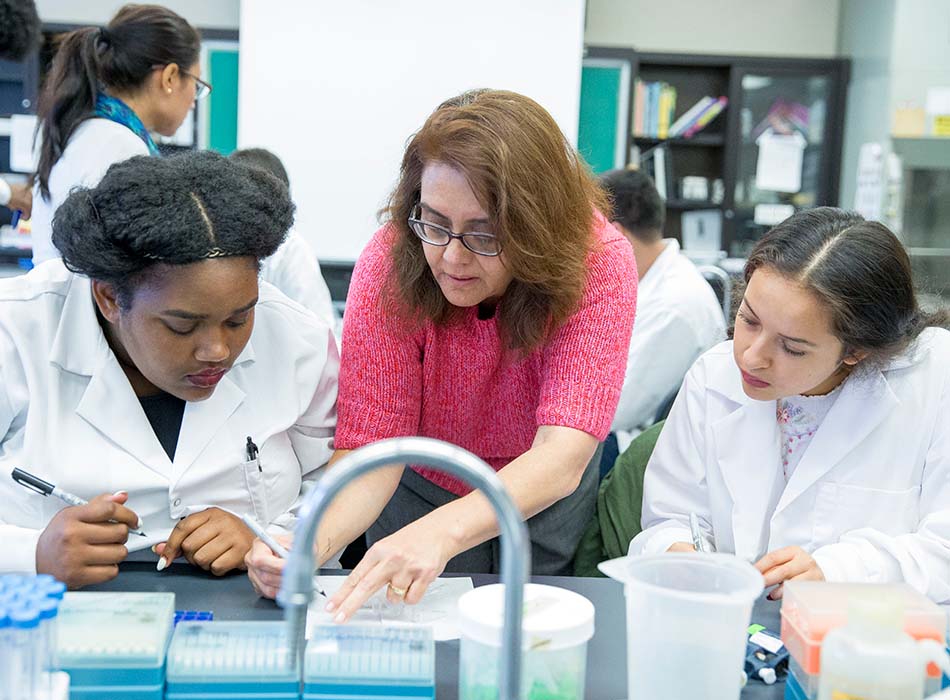
Leticia Márquez-Magaña talking to students

Márquez-Magaña working with Destinee and MC, two scholars in the first SF BUILD cohort.

“The lab’s current motto is ‘ground truthing community knowledge through science.’ What really shifted for us is that it’s not about [faculty] research questions. It’s about what the community wants to know,” she said.

The lab is a space with many tools and psychosocial support that students who are not represented in science need to realize, optimize and implement their scientific vision. Although each researcher brings their individual skills and wisdom, research is done collectively. This allows for better work across disciplines and encourages a communal approach to research that Márquez-Magaña has always implemented with colleagues.

“Others saw science as a battle: ‘We’re going to beat that research team’,” she shared of earlier experiences at research institutes. “It just never was a battle for me. I always knew that we were better working together. I think that’s because I was part of a minoritized group.”

In 2014, Márquez-Magaña helped establish the National Institutes of Health-funded SF BUILD to enhance the diversity of the biomedical research workforce. As SF BUILD’s lead principal investigator and core leader, Márquez-Magaña collaborates with faculty and staff at SF State, UC San Francisco and community organizations to transform teaching and research environments. Recently, the CSU’s STEM-NET hired Márquez-Magaña to bring more health equity research training and funding to the 23-school system.

“The CSU is where the workforce gets developed. What does the workforce do? The California workforce services the needs of Californians. We can do research that’s meaningful and impactful in our communities,” she said.

Learn more about SF State’s Department of Biology and SF BUILD.
A master’s degree despite detours: one alum’s inspiring story

Science communicator Yimy Antonio Villa (M.S., ’21) tells today’s students it’s never too late to finish what you started

In 2020, science communicator Yimy Antonio Villa returned (virtually) to his alma mater, San Francisco State University, to speak to students about his career. His main message: you have to take advantage of every opportunity that comes your way. Not long afterward, he got a chance to practice what he'd preached. 

Villa had been offering advice via Zoom to students in San Francisco State’s California Institute for Regenerative Medicine (CIRM) Bridges to Stem Cell Science program — a graduate program Villa himself had to first drop out of nearly a decade ago. After his talk, he got a message from the University’s CIRM Bridges Director Lily Chen.

“Lily Chen reached out to me and said, ‘You know that regret that you have [about not completing your master’s degree]? It doesn’t have to be a regret,’” Villa said.

Programs like the University’s CIRM Bridges — which was recently renewed for another five years — and the new undergraduate program CIRM COMPASS (Creating Opportunities through Mentorship and Partnership Across Stem Cell Science) train students in stem cell biology and expose them to a variety of career paths. And Chen wasn’t giving up on Villa.

At the height of the pandemic, he reenrolled in the University’s Cell and Molecular Biology master’s program with an emphasis in Stem Cell Biology, completing his graduate degree in 2021 — almost 10 years after he originally left the program.

The long delay for Villa resulted from family obligations. He came to SF State to get a master’s degree as preparation for a Ph.D. and managed to complete one year of the program before deferring for a year because his mother was experiencing health problems. Although he tried to return, he left again when he had to help his mother — an undocumented immigrant from Mexico — as his family’s primary breadwinner. He worked jobs outside of science, like as a receptionist for a pharmacy benefits management company, but always itched to return to the field he loved.

In 2016, SF State Biology Professor Carmen Domingo — at the time the University’s CIRM Bridges director and now dean of the College of Science & Engineering — forwarded a job opportunity at a nonprofit organization called Americans for Cures. The group educates the public about stem cell research and its impact on medical therapies. Villa snagged the job and started down a new career path.

The experience offered him a new way to apply his training as a scientist and taught him the art of sharing science to non-expert audiences. He also worked closely with patients and advocates who gave him a new perspective on medical research.

“It really highlighted to me the importance as a scientist or as anyone that is trying to propose a therapy or market some kind of a treatment … what makes it more important is that personal connection,” Villa said.

Around the time he returned to SF State in 2021, he was also working at CIRM as a marketing communications manager. After completing his master’s, he started a new position as manager of executive communications at Stanford Medicine, where he focuses on social media content and strategy for executive leadership.

Through it all, his mother — who did not have educational opportunities herself growing up — remained his biggest supporter. Now he’s a master’s degree recipient and an integral part of a larger communications team  — and she’s a legal U.S. resident planning on applying for citizenship later this year.

“Don’t be afraid to do a career change or to explore something else that you may want to do,” Villa said he now advises students. “Also understand that’s perfectly normal.”

Learn more about the University’s CIRM Bridges to Stem Cell Science program.

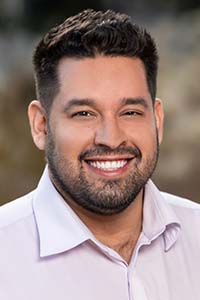
Headshot of a Yimy Villa smiling

Program trains the next generation of scientists and mentors

The Bridges to Doctorate program celebrates its 30th anniversary and its impact on University graduate students and the science community

In 1992, Michelle Alegria-Hartman (M.S., ’93) was a master’s student at San Francisco State University. She recalls frequently walking into the office of her thesis advisor, Biology Professor Frank Bayliss, to talk about science and her career. During one of these many conversations, Bayliss invited Alegria-Hartman to be the first student in what is known today at the University as the National Institutes of Health (NIH) Bridges to Doctorate program.

Now the program is celebrating its 30th anniversary — with instructors and students reflecting on the program’s impact. The program was recently awarded another $5 million from the NIH to continue for another five years.

“The purpose of the program is to support underrepresented minorities in the sciences, primarily biology and chemistry, but we’ve had students from physics, math and computer science as well,” said Bayliss, who served as director of the program for more than 26 years before retiring in 2018.

Bridges is one of several programs that fall under the College of Science & Engineering’s Student Enrichment Opportunities (SEO) office. In the 1980s, underrepresented minorities comprised less than 4% of the Biology master’s students at SF State. The introduction of Bridges and other programs has raised that percentage to 33.5% in the last decade and almost doubled the number of Asian master’s students. Analysis of 491 master’s students supported by SEO programs between 1992 and 2019 showed that more than half went on to complete a doctoral program (Ph.D. or MD) after SF State regardless of their undergraduate grade point average. That pattern of success represents what was observed in individual programs like Bridges, say Bayliss and current Bridges and SEO Director Megumi Fuse.

Bridges alums have entered different sectors of science, with many working in industry as researchers or executives, while others have gone into academia, education, law and more.

Financial incentives are important

“The program [Bridges] gives them some minimal funding but enough so [students] can focus on their studies,” Bayliss explained. Current students receive a stipend over $25,000 for the year and have 60% of tuition covered. They also have access to research opportunities and support for conferences, career development and Ph.D. preparation. That’s critical. While Ph.D. science students may receive a yearly stipend, there are far fewer opportunities for such funding for master’s students.

“If you look at women and minorities, they’re not going to be coming from families that can just support them to get a master’s degree or Ph.D.,” explained Alegria-Hartman, who now works in private industry. “You have to have financial incentives.”

As a graduate student, Alegria-Hartman also held a separate research job at Lawrence Livermore National Laboratory. Bayliss helped her coordinate her research at Livermore so it could do double duty as her master’s research project, a move that helped her balance her school workload and financial needs. After SF State, she completed her Ph.D. at the University of California, Davis.

Twenty years later, LeRoy Robinson Jr. (M.S., ’12) partly came to SF State because he knew about Bridges and other support for master’s students.

“SF State was also one of the few institutions for master’s students where they are also offering some kind of financial support so I wouldn’t necessarily have to go broke to do my master’s,” Robinson said. He did his master’s thesis research with faculty at the University of California, San Francisco, and went on to pursue a Ph.D. at New York University.

Mentees to mentors

“It’s a part of my responsibility to give back to the community,” Alegria-Hartman said. “I literally always say this: I wouldn’t be where I am today if it hadn’t been for a lot of people stepping forward and becoming my mentor.  I believe mentors are key for students choosing a scientific career and obtaining their career goals.”

They also treated her like a colleague: SF State faculty would frequently share with her their recent scientific findings or interesting research papers. It felt like they were inviting her into the fold of being a researcher, which had a huge impact on Alegria-Hartman as a young scientist. They took the time to understand her goals and helped her navigate academia, grants, applications and personal decisions. Robinson says he had a similar experience.

“SF State was the only place, especially in the sciences, where I didn’t feel like the sole person of color that was in the room in conversations,” he said, noting that diversity and representation are important in his own career choices. In addition to being an SF State adjunct faculty member and lecturer, he is an associate medical director at a medical strategy agency (Prohealth) and a diversity, equity and inclusion associate editor for the journal “Women’s Health.”

Given SF State’s demographics, Alegria-Hartman thinks the University’s and Bridges’ impact is important for the health of the science field. The authentic care and education at SF State is key to giving a more diverse group of budding scientists the opportunity to blossom.

“It’s getting people in the pipeline. … Getting as many people as you can involved in the beginning of a scientist’s career and seeing if they really like science or not,” she said. “I think that really, really helps.”

Learn more about NIH Bridges to Doctorate and other similar programs offered by the Student Enrichment Opportunities office.