SFSU hosts inaugural AI hackathon

Student organizations, community partners convened to use AI to solve real-world issues
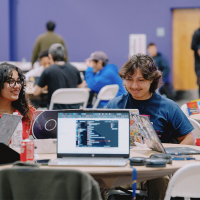
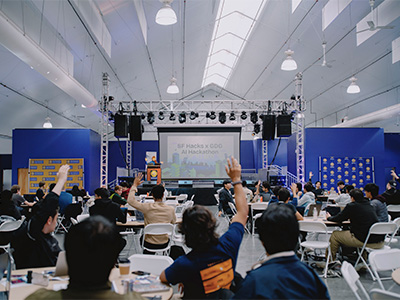
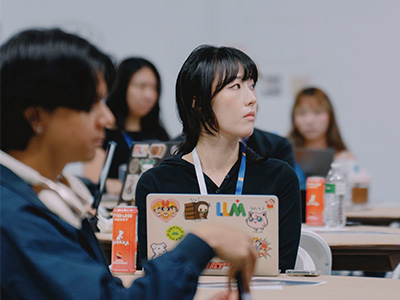
On Friday, Oct. 3, students filled San Francisco State University’s Annex 1 for SF Hacks x GDG AI Hackathon, the University’s first hackathon dedicated to artificial intelligence.
The event was organized by two student organizations: SF Hacks and the University's chapter of the Google Developer Group (GDG) which is supported by Google. The SFSU AI Student Commons sponsored the event as a way to show University support for students putting skills into practice. Together, the groups set out to give their peers — particularly beginners — a supportive environment to learn, network and create innovative solutions using AI. Participation was open to students from any university.
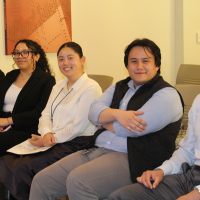
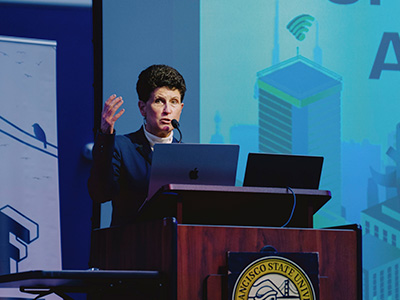
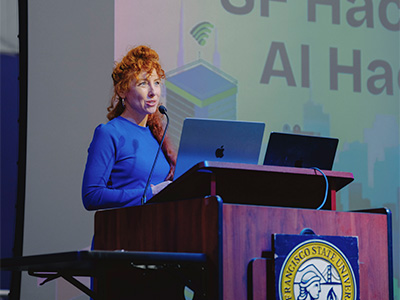
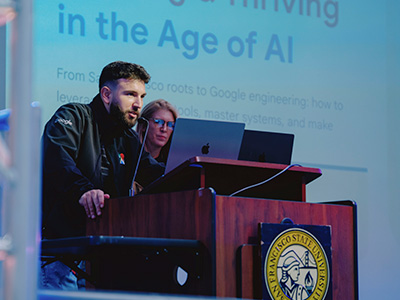
During the opening ceremony, SFSU President Lynn Mahoney celebrated the collaboration behind the event, which brought together student organizers with support from the University, regional industry and community partners.
“This is a student-driven event,” Mahoney said, thanking SF Hacks and Google Developer Groups for their work. “Supported by the University, supported by regional industry, the Bay Area Council and Google. This is it. This is how we change the world.”
Kelly Cure, vice president of public policy at the Bay Area Council, joined Mahoney as a speaker during the opening ceremony, emphasizing the value of pairing technical skills with curiosity to explore AI. The council is working with SFSU through AI For All, a future initiative aimed at expanding AI literacy in the Bay Area.
“[We’re] super excited to have the Gators, SFSU, as anchor partners in this program,” Cure said.
For the student organizers, building community was as important as building with AI.
“I really hope they take away that SFSU is a community. It’s somewhere you can thrive with other people and brainstorm and take your ideas and put them into real-life applications,” said David Ghukasyan, a Business Analytics and Statistics double major and lead ambassador of the SFSU AI Student Commons. “If [students come to the hackathon and] actually talk to other people about it and get a different perspective, then in my eyes, that’s a success.”
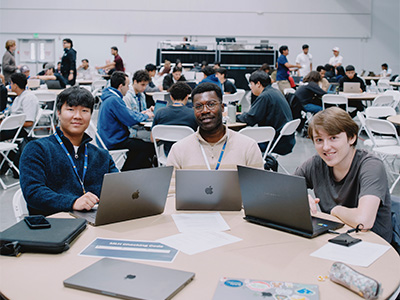
Participants worked as individuals or groups to create AI-related projects that fit into four tracks, including an SFSU track encouraging projects that would make life easier for SFSU students or anyone in the University community. Judges award more than $2,000 in prizes.
Students created projects that helped peers with wayfinding, scheduling, delegating for group projects and finding free food on campus. Other hackers created tools to support teachers specializing in dyslexia and help older adults interpret medicine labels and manage post-hospital visit instructions.
At noon, organizers invited the wider campus community into the conversation with “Live from the Hackathon: SFSU Students on AI,” a Zoom discussion where a panel of four students from Business, Statistics, Computer Science and Public Health spoke with the SFSU community about AI.
“It’s super important to have these conversations because when we don’t, silence kicks in and we have a lot of assumptions,” Ghukasyan said. He, along with his fellow panelists, honestly discussed their AI usage, the pros and cons in their view and how they’d like to see faculty and staff use and regulate AI on campus. Some students admitted their distrust of the technology.
“At SFSU, [AI is] something we are very open about. [We] have people who talk negative on the matter and we have people who talk positive on the matter. We can get that common ground and learn as a community,” Ghukasyan said.
Community partners were also in attendance to help kick off the event, mentor during the program and judge final projects. Alumnus Taso Grigoriou, now a Google software engineer, and Monica Kelly, Google corporate counsel and legal AI enthusiast, joined the opening ceremony. In addition to sharing his journey, Grigoriou discussed his job and shared his perspective on students’ burning questions, including “What’s the quality that people look for when hiring software engineers?”
“I started at City College, dropped out to pursue music, came back two years later, started as a math major initially and pivoted quickly to computer science when I fell in love with making iOS apps,” Grigoriou (B.S., ’19) said about his own path. “From there, I leveraged some of those side projects, iOS apps, to an Ancestry internship in the city and then I joined Google right out of college in 2019. I’ve been there since.”
Tags
Related News