Artificial Intelligence

SFSU holds faculty symposium on ‘Research in the Age of AI’

Feb. 20 event creates space to share and critically examine emerging tools and practices

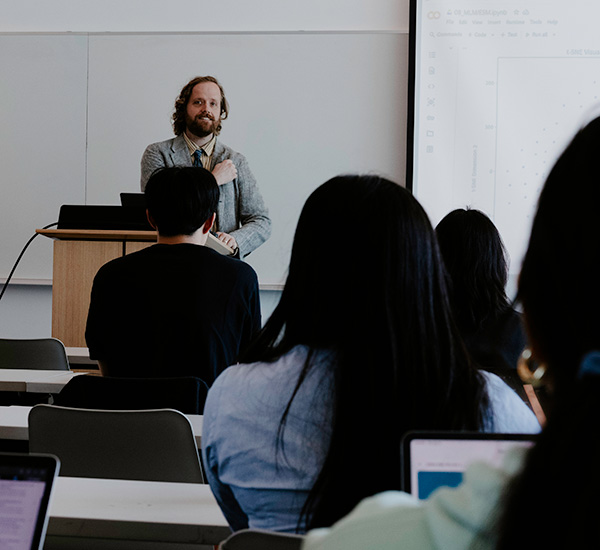
San Francisco State University hosted the “Research in the Age of AI: SFSU Faculty Symposium,” a dynamic half-day gathering on Friday, Feb. 20, 2026, that convened faculty from across disciplines to explore how AI is transforming the research landscape.

Designed as both a showcase and a conversation, the symposium featured a keynote address by Gaurav Suri, an engaging panel on AI ethics and digital responsibility and 15 lightning talks highlighting innovative AI-driven research and methodologies underway at SFSU. The event created space not only to share emerging tools and practices, but also to critically examine the opportunities and responsibilities that accompany AI’s growing influence in scholarly work. Concluding with a faculty mixer to encourage continued dialogue, the symposium fostered interdisciplinary connection and positioned the University community to thoughtfully navigate research in the age of AI.

Please visit the campus AI website for the program and presentation slides from the “Research in the Age of AI” symposium.

Videos of the keynote address and panel discussion are embedded below.

Keynote: ‘The Emergence of Intelligence in Machines’

“There’s a lot of noise about AI. It’s not the answer to all of our problems and it’s not this horrible thing that should never be used. It’s both. It’s a tool. And we need to understand what the tool is and what its limitations are.” — Gaurav Suri, associate professor of Psychology

Ethics panel

Panelists: Carlos Montemayor (Philosophy), Sepideh Modrek (Economics, Health Equity Institute and Institutional Review Board), Zainab Agha (Computer Science), Chris Koenig (Communication Studies, Institutional Review Board)
SFSU launches first-ever student AI awards

New initiative highlights how Gators are engaging with one of today’s most transformative technologies

San Francisco State University is calling on students to apply bold thinking to the future of artificial intelligence (AI) while getting recognized for it. The inaugural SFSU Student AI Awards spotlight the creativity, curiosity and critical thinking students are bringing to today’s most transformative technology. From building innovative tools and AI-driven art to exploring ethical boundaries or solving real-world challenges, the competition celebrates how Gators are engaging with AI in meaningful ways. 

“The SFSU Student AI Awards give students a unique opportunity to showcase and apply AI in real-world situations while thinking critically about its impact, both positive and negative,” said David Ghukasyan, a member of the Awards Organizing Committee.  

An SFSU Data Science student, Ghukasyan is actively involved in AI initiatives across campus and beyond. He serves as event coordinator for the AI Agents Club, is a student ambassador for OpenAI, helping to facilitate workshops and events, and works part time as a business development and fundraising strategy analyst for Accel.AI, supporting efforts to build partnerships and secure funding for AI-driven projects. 

“I’m excited to see how students bring their perspectives to life and highlight the work coming out of SFSU,” Ghukasyan said. 

The awards feature four categories that reflect the diverse ways students can work with AI: 

  • “Problem Solving with AI” focuses on practical, real-world applications. Students are encouraged to develop solutions that address business, social or technical challenges using AI in thoughtful and effective ways. 
  • “Integrating AI into Creative Expression” celebrates artistic innovation, inviting submissions in visual art, music, writing, film, design that thoughtfully incorporate AI while exploring questions of authorship and creativity. 
  • “Exploring Societal Impacts and Perspectives” challenges students to critically examine AI’s broader effects, from ethics and bias to privacy, labor and policy through research, analysis or multimedia storytelling. 
  • “Innovation” offers an open-ended space for bold, interdisciplinary or unconventional ideas that push boundaries and don’t fit neatly into a single category. 

“This is about more than just technology,” said Andrew Roderick, assistant vice president of Academic Technology. “It’s about how students are thinking, experimenting and shaping the role of AI in their academic work and future careers.” 

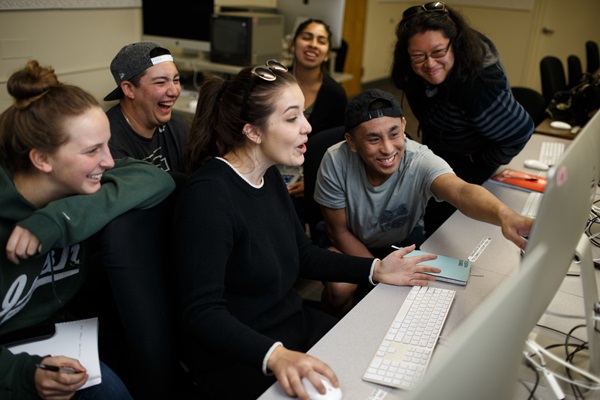
Laughing students look at something on a computer screen

Why you should get involved 
Participants won’t just gain experience: They’ll gain visibility. Top winners in each category will receive $500 awards, and all approved submissions earn a certificate and digital badge. Selected projects will be featured on the SFSU AI website, with finalists presenting their work to industry leaders and professionals. It’s also an opportunity to build a standout project for a résumé, portfolio or graduate school application. 

Open to every Gator 
Any student with an interest in AI is encouraged to participate: The competition is open to all SFSU students, whether participating individually or as part of a team. 

All projects must be original and demonstrate responsible AI use in alignment with CSU guidelines.  

From idea to pitch 
Students can get started by submitting a proposal that includes a project title, a 250 – 500 word description and an overview of their approach and AI tools. Selected participants will advance to the next round, creating a five-minute pitch video. 

Submissions are open through Friday, April 10.  

Support along the way 
Academic Technology will host open forums and office hours to support students throughout the process, offering guidance and feedback as ideas take shape. 

Have an idea about working with AI? Now’s the time to share it! Learn more about the SFSU Student AI Awards.