Tale of the lava heron: SFSU student describes new Galapagos species
A longstanding SFSU-Cal Academy partnership enables high-caliber SFSU student research
The Galapagos Islands are famous for the discoveries that shaped Charles Darwin’s theory of evolution. Now an SFSU graduate has added one more: Ezra Mendales (M.S., ’23) describes a new species as part of his master’s thesis.
“I feel super lucky with this project. I think we fell into this beautiful story that is really rare,” Mendales said of his work with SFSU Associate Professor Jaime Chaves and California Academy of Sciences Ornithology Curator Jack Dumbacher.
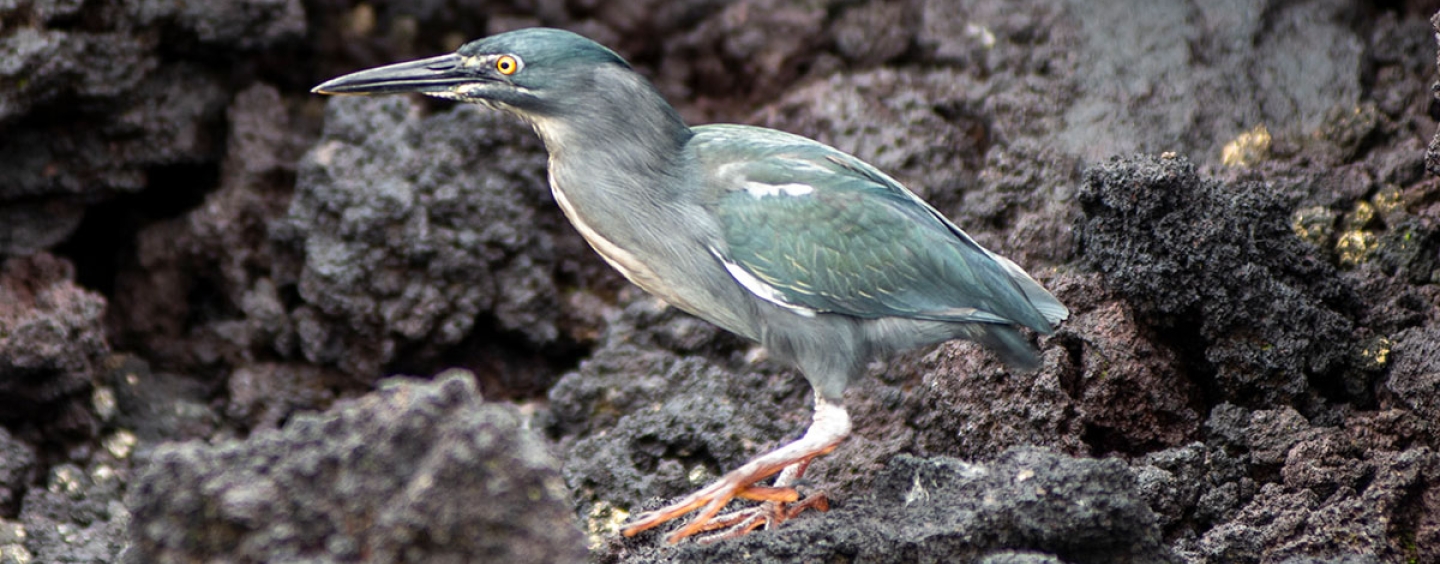
They found that the common Galapagos lava heron (Butorides sundevalli) is a distinct species, upending a decades-long assumption that it is a subspecies of the South American straited heron.
“I’d say the vast majority of ornithologists alive today have never been part of a new species description,” said Dumbacher, who shares a lab with Chaves and was on Mendales’ thesis committee.
A mystery in plain sight
The Galapagos lava heron is one of 72 new species recently described by Cal Academy researchers and collaborators. Unlike many discoveries of uncovering hidden species, the lava heron is a common sight in the Galapagos.
“There was always this bird that shows a lot of variation in its plumage, and for a long time there was questions of whether this was a separate species or a subspecies of a bird that lives on the mainland,” Chaves explained. Scientists have been studying these birds for decades and have tried to provide explanations based on their morphology and plumage, but no one provided a definite answer.
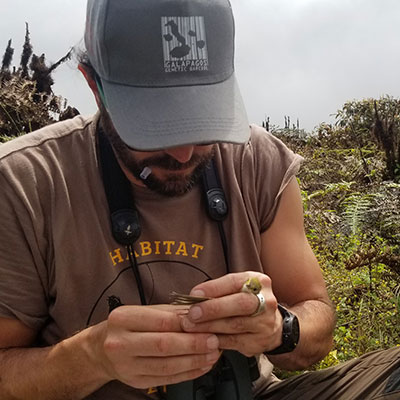
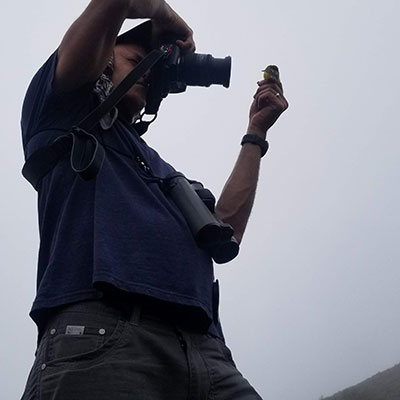
When Mendales joined Chaves’ lab, he took on the challenge. In 2022, the trio went to the Galapagos to collect samples. To understand the evolution of these birds, they needed more data — particularly from different locations and over time, and to capture the entire plumage variation — so they added specimens from the Cal Academy, American Museum of Natural History and the Field Museum to their dataset.
At the Academy’s Center for Comparative Genomics, Mendales used advanced genetic analyses to study the bird’s DNA. The results showed the Galapagos lava heron is a distinct species more closely related to the North American green heron than to the South American species, challenging earlier assumptions based on morphology.
“For any biologist, it’s a dream to be able to go to the Galapagos,” Mendales explained. “We are still learning things about some of the most investigated systems. There’s always going to be mysteries to solve.”
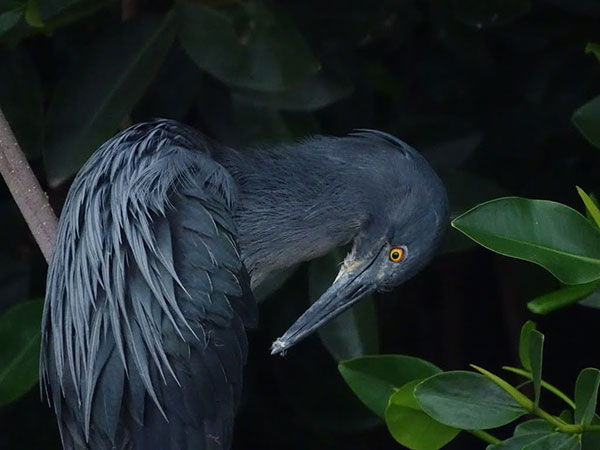
Photo credit: © Ezra Mendales
Convergence of stories
As an Ecuadorian, Chaves first visited the Galapagos Island with his family when he was 6 years old. The Galapagos Islands’ people, culture and wildlife became constants in his life. Chaves’ continuing fascination with the islands drives his research and work in the Galapagos community, which includes training tour guides.
“You have to have this collaboration with the locals. Somebody who really knows the birds on the ground,” Chaves said.
In this case, the local expertise came from Jason Castañeda, a Galapagos National Park ranger who helped the team catch the herons so they could collect blood samples.
“He’s a co-author on our paper because it’s a substantial collaboration,” Chaves said.
While Chaves says the Galapagos draws students to the lab, Mendales, now a Ph.D. student at the University of Montana, is quick to credit his SFSU mentor instead. He first met Chaves in 2015 during an undergrad trip to the Galapagos and revered his expertise before coming to SFSU for his master’s work.
“Getting access to not only the faculty at San Francisco State but the resources and employees at the California Academy of Sciences — it’s a match made in heaven,” Mendales said.
Dumbacher, who has been at the Academy since 2003, was also familiar with Chaves’ expertise before Chaves became an SFSU professor. Establishing a joint lab to study the Galapagos was a natural extension of their interests and partnership. The Cal Academy alone has the world’s largest collection of scientific specimens from the Galapagos, dating back to 1905.
“Working with Jaime has been one of the most fun things I’ve gotten to do in my career. It’s really rare that somebody like me at a museum will have a collaborator that is so aligned,” Dumbacher explained.
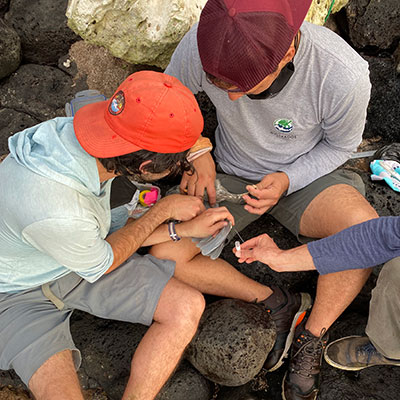
Photo credits: Jaime Chaves and Ezra Mendales
The root of your goal
“Our students have access to things a lot of students in other labs don’t have,” Dumbacher said about the strength of the SFSU-Cal Academy partnership. Students get to benefit from the Academy’s connection to biotech, local research institutions and companies creating new technologies. “Seeing somebody like Ezra, who was interested in but didn’t have the [molecular biology] background in the lab, go from zero to 80 so quickly was really fun.”
But Mendales says this experience has given him far more than just access to resources and expertise. His SFSU mentors recognized that students bring a wide range of backgrounds and interests to their work and helped him channel those experiences into a clearer sense of purpose. They encouraged him to think deeply about why he does the work he does. “What they [helped] me with was finding the root of my goal. Not what is my goal, but what do I want out of life,” he said.
It’s an experience that echoes his mentor’s journey. Although Chaves became an SFSU professor in 2020, he first came to SFSU in 2002 as a master’s student. He studied hummingbirds with SFSU Professor Gretchen LeBuhn.
“I came in to do my master’s with a different perspective. I walked out of the lab the first day after I worked with DNA helping Professor Ravinder Sehgal, a postdoc at SFSU at that time. It changed my idea of research by 180 degrees,” Chaves said. He’s been using genetics to study bird evolution ever since.
“The Biology Department at SFSU has an amazing record of placing their master’s students in Ph.D. programs,” Dumbacher said. “At SFSU you have a really high caliber of master’s students and also professors teaching them … It takes a special kind of professor that is good at research but is also a good teacher who is committed to teaching.”
Tags
Related News