Gilead Innovation Initiative opens doors for SFSU student scientists
The new initiative provides stipends, lab support and opportunities for first-time and emerging researchers
Elmer Guzman didn’t always see himself as a researcher. A first-generation Chemistry senior at San Francisco State University, he wasn’t sure he belonged in a lab until this summer, when he became one of the first Gilead Innovation Initiative Scholars.
“It makes me feel proud of myself,” Guzman said. “Just seeing the recognition and knowing that there are opportunities trying to help students who are new to research makes me feel like there is a future to these things.”
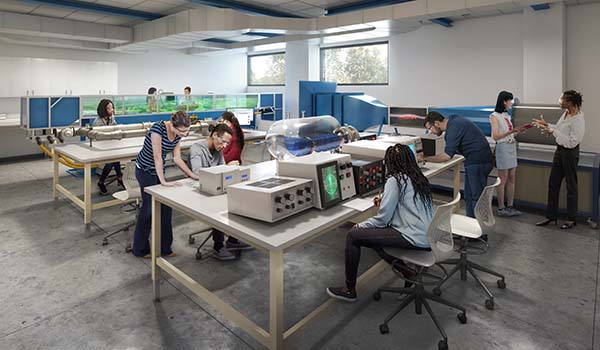
Guzman is one of 30 student scientists who made up the first cohort of the Gilead Innovation Initiative at SFSU. The Gilead Foundation generously gifted $1.25 million in programmatic support to SFSU’s College of Science & Engineering (CoSE) via two awards during fundraising for the University’s new Science and Engineering Innovation Center (SEIC). In addition to supporting student research activities, the foundation also provided $3.75 million to outfit SEIC labs with state-of-the-art equipment and furnishings.
The Gilead Innovation Scholars — 11 undergraduate and 19 graduate students — were awarded $5,000 stipends to conduct research between June 1 and August 23. (Faculty members were also awarded a $1,000 honorarium for mentoring the scholars). Many of the student awardees were first-time researchers as well as students who had never received financial support for working in research labs.
The Gilead award is unique in that it is inclusive of research activities throughout CoSE. It included at least one student from each of the eight CoSE departments and schools, supporting the training of astronomers, biologists, chemists, computer scientists, engineers, geologists, mathematicians, physicists, psychologists and others. Projects ranged from molecular biology and ecology to nanoparticles, artificial intelligence, youth psychology and many other topics in science and engineering.
‘I’m moving in the right direction’
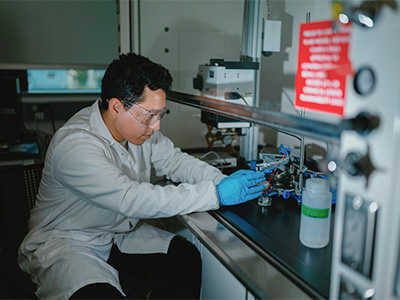
Guzman spent the summer in Associate Professor Jingjing Qiu’s lab, exploring chemistry and renewable energy. He is testing the stability of gold and nickel in electrodes for the electrochemical oxidation of benzyl alcohol. His work could one day help make industrial chemical processes more sustainable. But for him, the more immediate outcome was confidence.
“I definitely see myself going down this route, trying to pursue higher education and keep doing research,” he said. He’s already presented his work on campus and is excited to continue this work and possibly attend an external scientific conference later this year.
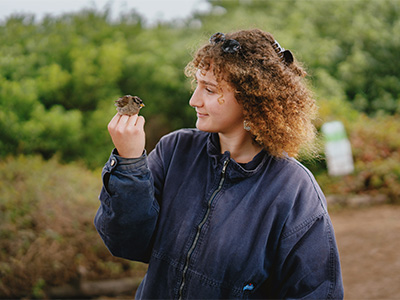
As Guzman pushed the boundaries of renewable energy in the lab, Lilly Raphaelian was outdoors gathering clues about a new avian virus that could impact local bird ecology. As a second-year Cellular and Molecular Biology master’s student working with Biology Professor Ravinder Sehgal, she studies Russian Doll Virus (aka Matryoshka virus), a virus that infects a parasite that infect birds — hence the Russian doll moniker. The parasite is the number-one killer of birds and is widespread in warmer climates.
Beyond wanting to understand how the virus is impacting the parasite, she is also optimizing an imaging technique (RNAscope) to detect the virus in blood smears. The technique is typically done with tissue samples, but her approach is safer for birds.
There are a lot of unknowns and challenges, Raphaelian explains, but the experience has been rewarding. She considers this her first proper research experience — “[The Gilead award] is my first grant ever!” she added excitedly — and in just one year she’s written proposals and grants, learned research skills, created posters, given scientific presentations, taught students in and out of the classroom and collaborated with local and international scientists.
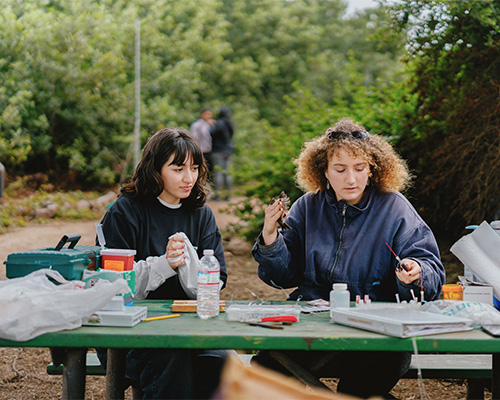
“It feels like I’m moving in the right direction,” Raphaelian said, noting she wants to become a professor. “I hope to achieve many more grants in my lifetime. It’s making me feel like I’m capable and I’m supposed to be here.”
‘There’s an astrophysicist that looks like me!’
A Ph.D.-bound grad student like Raphaelian, Gabriel Munoz Zarazua was always fascinated by the mysteries of the universe. But he didn’t always think he could be an astrophysicist. Thanks to his own perseverance and support from mentors (and the Gilead Foundation), he’s now an SFSU astrophysicist collaborating with researchers all over the nation.
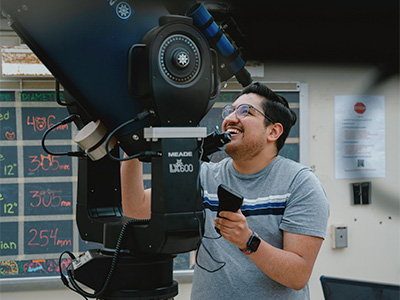
Working with Physics and Astronomy Assistant Professor Eileen Gonzales, Munoz Zarazua is studying the formation of Ross 458 c, a brown dwarf planet that orbits a binary star system. Although they form like stars, brown dwarfs lack the mass to radiate starlight so they fall somewhere between a star and a giant planet.
To better understand Ross 458 c, Munoz Zarazua is using data from the James Web Space Telescope (JWST) to examine the object’s atmosphere. It could offer new insights into how this brown dwarf formed and help define and compare brown dwarfs, planets and stars.
Munoz Zarazua is also part of a larger scientific collaboration with scientists from all over the country. He meets with the group every few weeks and has interacted with collaborators at scientific conferences. The experience has been invaluable because these collaborators may become future colleagues or mentors during his Ph.D. or later in his career.
Despite his passion for astronomy research, Munoz Zarazua was hesitant to commit to this path. Earlier in his career, he didn’t think he had the necessary math skills and was discouraged by the lack of scientists who looked like him.
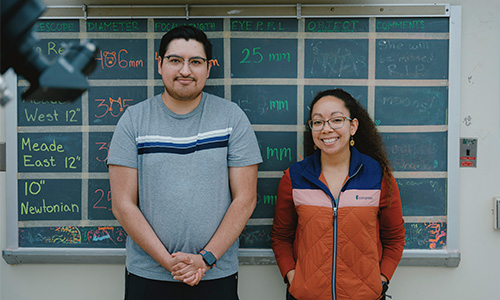
“Now I’m starting to see more. I just got back from a conference in Washington, D.C., and we talked about that,” he explained. “It was so amazing to meet other people that look like me. I want to be that for other students, for the next generation. For them to look up and think, ‘There’s an astrophysicist that looks like me. If they can do it, I can do it too.’”