Students

SFSU students gain unlimited free rides on Bay Area public transportation

Gator Pass serves as a passport for students to travel within San Francisco and throughout the Bay Area 

With just a tap of their student ID card, San Francisco State University students now have the keys for traveling throughout the Bay Area for free. 

San Francisco State students now enjoy free unlimited rides on public transit throughout the Bay Area during the fall and spring semesters. All they have to do is tap their SF State One Card when boarding. 

As of Aug. 26, the expanded Gator Pass covers 22 transit agencies spanning all nine Bay Area counties. Attention, all Gators from the East Bay: Yes, it includes free Bay Area Rapid Transit (BART), AC Transit and even the San Francisco Bay Ferry. And to the South Bay Gators: Yes, you can ride CalTrain for free, as well as Valley Transportation Authority (VTA). Previously, the Gator Pass only included unlimited rides on San Francisco Muni and SamTrans, plus a discount on BART. 

Even with all of the new benefits, the Gator Pass student fee is now cheaper: $130 per semester, which is $50 less than previously. 

“Having majority commuter students, we see how beneficial it is already having the previous benefits,” Associated Students President Brandon Foley said. “We have a lot of students coming from all around the Bay Area and beyond, so we wanted to make sure that everyone is getting affordable transportation.”  

Students enjoy significant savings from the Gator Pass, as an adult pass for unlimited rides on Muni costs $81 per month. According to data from SF State’s Office of Sustainability, commuting 10 miles to campus four times a week by car costs $250 – $325 per month. 

Foley commutes to SF State from San Bruno, taking BART and Muni. He does not own a car. 

“I always love exploring around San Francisco. I love West Portal and Embarcadero, just going and finding new spots to eat around there,” he said. “I really love public transportation and I’m a super big advocate for high-speed rail. I’d love to see that in California.”  

The free rides are a result of student feedback and advocacy from SF State’s Associated Students, which surveyed students about expanding the Gator Pass in lieu of introducing a voter referendum. Associated Students was the original driving force behind establishing the Gator Pass, passing a transit pass resolution in 2015. The Gator Pass went into effect in fall 2017.

Visit the SFSU One-Card website to activate your Gator Pass and learn more.   

SF State welcomes students to campus residence halls

New six-story West Grove Commons adds 751 beds to University Housing 

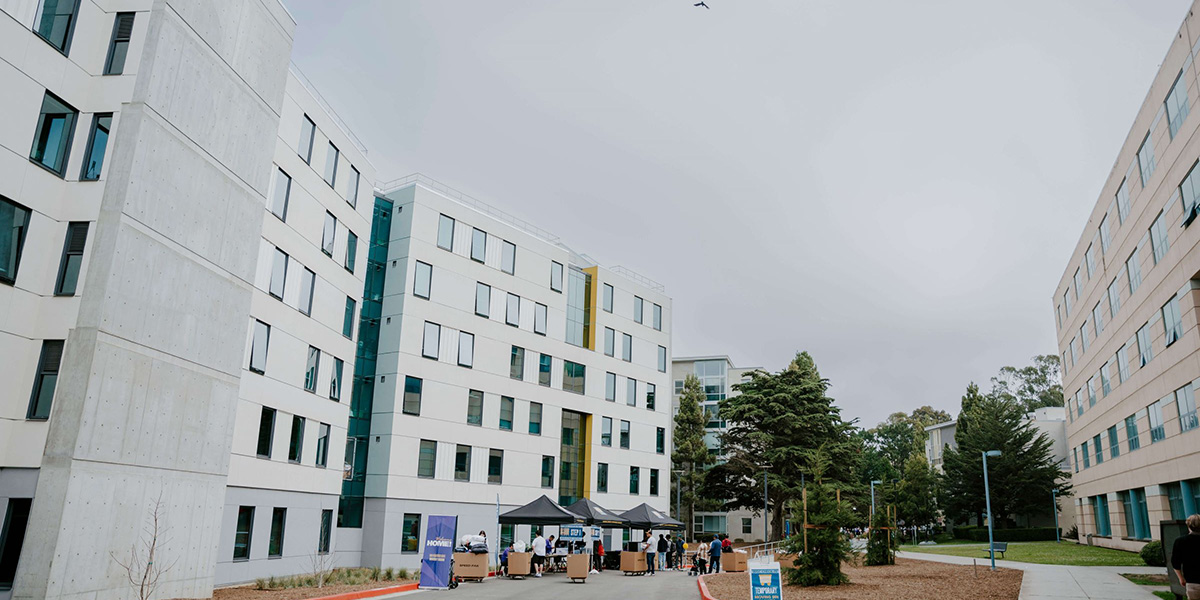
Warm weather is far from the only thing that students brought to San Francisco State University on Aug. 21 when moving into campus residence halls. Under sunny skies at 70 degrees Fahrenheit, thousands of students pushed boxes on wheels full of their belongings, hauled from their hometowns into their new homes for the next nine months. 

Clothing, sheets, hampers, toiletries and school supplies are a must of course. But so are stuffed animals, plants and posters of their favorite bands. 

“I brought my footballs because I like to stay active. I have a fan because it helps me sleep, for the white noise,” said Patrick Mendoza, a Photojournalism major entering his fourth year in the residence halls at San Francisco State.  

Estefania Solis, moving into the Village at Centennial Square, made sure to pack photographs of her friends because she plans to decorate her wall with them. She also brought her new Dumbo stuffed animal to keep in her bed. 

“I wanted to move into a city — not super far, but not super close either,” said Solis, who is transferring to SF State from Folsom Lake College to study Accounting. “I’m excited to explore the city. I’ve never been on my own before. I look forward to meeting new people and finding new interests.” 

This year marks the opening of the West Grove Commons, a 751-bed building rising six stories high. It introduces a “pod-style” living environment to SF State’s residential community. There are an average of 12 rooms per pod and four pods per floor. Each floor includes a shared all-gender bathroom, and study and lounge spaces. An adjacent new building for the Gator Health Center and dining commons will open in early 2025. The project is supported by $116 million from California’s Affordable Student Housing Grant Program.    

A new reduced-rate student housing program also launched this fall. The first program of its kind in the California State University system, it offers housing at approximately 25% less than the traditional rate to students who meet the qualifications to receive a Cal Grant A or B financial aid award. 
SF State President Lynn Mahoney walked her way through the campus residential communities to greet families and University Housing staff. “The weather is always this nice,” she joked to a family from San Diego. This family was dropping off two of their triplets rooming together in the Towers at Centennial Square. “San Francisco was our only choice,” said Claire Gaines, a Kinesiology major. “In San Francisco, there are a lot of opportunities to grow your career.” 

Her sister Gianna Gaines, a Child and Adolescent Development major, added: “There is so much to do. It’s different than back home. There’s so much good food. I love Chinatown.”  

Learn more about on-campus housing and apply online

Coffee, pho, syllabus: Students offer peers advice on living the Gator life

Through two peer mentor programs, students help students connect, learn and thrive

Whether you’re new or returning to San Francisco State University, you have access to a variety of resources, the most valuable being your peers. Students in San Francisco State’s Peer2Peer Mentor Collective and First-Year Experience (FYE) Peer Mentor program have a wealth of advice to offer on the key to balancing a college career and city living.

The mentors are continuing students who meet regularly with new students, most often virtually. In the Peer2Peer Mentor Collective, students text each other most frequently, while the FYE students most frequently meet in person. 

Kenya Bravo, an SF State student and FYE peer mentor, emphasizes the importance of keeping your life organized. She says students should use a planner (or a calendar or reminder app on their smartphone) to keep track of tasks, events and activities. Bravo also recommends reading the class syllabus as early as possible. 

“Not every professor is going to go over the syllabus,” she said. “It’ll tell you a lot of things you’d want to know, like dates for assignments and your grade breakdown.” To save money, she adds, students may be able to find free digital versions of textbooks. 

On the first day of classes, student mentor Rishika Patel likes to arrive to the classroom 10 minutes early. “You can pick out your seating, you can meet other students in the class and prepare yourself before the professor starts lecturing or explaining the syllabus,” she said. 

Even if you already know your way around the 144-acre campus, new discoveries await around the corner. SF State is home to more than 60 student resources and more than 200 student organizations. Student mentor Alpana Kallianpur suggests getting acquainted with where resources are located. “It’s important to know what you have available around you,” Kallianpur said.  

Student mentor Dylan Gillespie notes that the Student Services building is a central location for in-person assistance from Admissions, Financial Aid, the Registrar’s and Bursar’s offices, One Card, Student Engagement and Transition, Student Support Services, Disability Programs and Resource Center, and Veterans Services. The building is also home to the Dream Resource Center, Educational Opportunity Program, Counseling and Psychological Services, and Diversity, Student Equity and Interfaith Programs. The centers for Undergraduate Advising and Career and Leadership Development are in the Administration building. 

“They’re all extra support — here to support you,” Gillespie said. 

Sometimes, finding a coffee on campus or the best pho in the Bay Area might be your priority. When student mentor Isabella Sofia Ceja arrives on campus, she grabs a boba drink from Quickly outside of the Cesar Chavez Student Center. When she needs a recharge, she goes to Cafe Rosso for a cup of coffee and a bagel stuffed with bacon, eggs and cheese. When she is ready to leave campus, she takes the bus to Kevin’s Noodle House in Daly City. It’s only a 10-minute ride from the SFSU campus. 

“The Bay Area weather always puts me in the mood for pho,” Ceja said.  

Patel’s final piece of advice is something that students have been doing since kindergarten: “Make friends in every class that you have.” 

Students can sign up online to find a Peer2Peer mentor or become one themselves. Visit the Peer2Peer Mentor Collective web page to learn more and get involved

Learn more about the FYE Peer Mentor Program

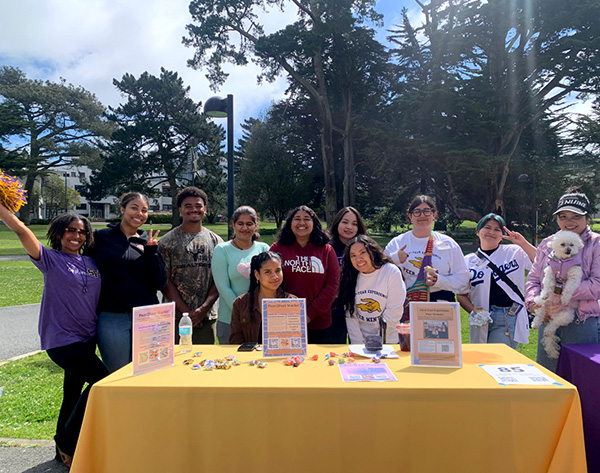
Members of the Peer2Peer Mentorship Collective, with one of them holding a dog, pose for a picture while tabling on the Quad on a partly cloudy day

SF State pilot program trains students to handle art — and they’re already landing jobs

Funded by a California State University grant, the 12-unit pilot program is designed to diversify the field of art handling 

For the past year, Art students at San Francisco State University set aside their easels and learned the trade-skills aspects of the art world. A pilot program in Art Handling teaches students the proper ways to handle art and prepare them for careers in museums, galleries, auction houses and beyond. The 12-unit program is among the first of its kind at a public university, training students in a field where no academic degree program exists, anywhere. 

Students have found themselves driving a forklift, riding a scissor shift, drilling wooden cleats into walls of the Fine Arts Gallery on campus and more. The experience they’ve gained since beginning the program last fall has already landed them work at venues such as the de Young Museum, Contemporary Jewish Museum and California Institute of Integral Studies. Many of the 15 students in the pilot program had never even heard of art handling. 

“This program has been transformational,” said Adrian Morelock-Revon, a sculptor who graduated with a bachelor’s degree in Art History this year. “I was goal-less coming back to university. Now I have more direction.” 

For Public Health major Megan Rogers (B.S., ’24), the Art Handling program has introduced her to new community. 

“I took a ceramics class and fell in love (before enrolling in Art Handling),” Rogers said. “This has been a really big confidence boost. It has been wonderful to connect with like-minded students.” 

Other students in the cohort have made discoveries both practical and symbiotic. 

“I’m much nicer to my own artwork now, especially storing it,” said Emma Purves, a multidisciplinary artist, as she and two classmates wrapped sculptures from the most recent Fine Arts Gallery exhibition. “I used to keep it in a pile without thinking about long-term damage.” 

Valerie Mata, who completed a bachelor’s degree in Studio Art this year, has found that there is much more to art handling than hanging, packing and shipping. 

“I’ve gained a strong idea of my environment and community, delving into this portion of the art world with people closer to my age and getting into the museum world and curatorial projects,” she said. “We see a different side. It gives me continuous learning.” 

Art handling is a mid-level position secured through on-the-job training, word of mouth and unpaid internships, which is not economically feasible for most San Francisco State students, as stated in the grant proposal that was funded by the California State University Creating Responsive, Equitable, Active Teaching and Engagement (CREATE) Awards Program. It was the only arts-based program to win a CREATE award for 2023 – 2024. The program also aims to diversify the field of art handling. The overall workforce is more than three-fourths white and male, according to data compiled by the Broad Museum. 

“A program like this really does open the diversity in this industry. By happenstance or not, the industry is really white and male dominated,” said Kurt Otis (B.A., ’18), one of two alumni tapped by the School of Art to mentor students. He is the lead art handler for the Minnesota Street Project’s Art Services department in San Francisco. “The semester is a short time, but my mentorship with the students truly lasts longer. I told them, ‘You have my phone number. You have my email. ... Let me help you transition into the professional world and even beyond.’” 

The other mentor, San Francisco Museum of Modern Art Preparator Ximaps Dong (B.A., ’19), has shown students how they install artwork in their job as well as for friends at neighborhood galleries. 

“I’m able to use the resources and my community to help students out,” Dong said. “And also, just like, make it approachable because I feel like the art world can be a little scary and foreign.” 

“We want to create those network connections now,” said Art Lecturer Kevin B. Chen, who directs the program with SF State Fine Arts Gallery Director Sharon E. Bliss. “If we can help restructure the network, we can help diversify it.” 

“We’ve also gotten incredible feedback from institutions. They’re saying that they’ve been waiting for something like this,” Bliss said. “The word is getting out and folks are just like, ‘How do we support you? How do we get these trained students into our workforce?” 

The students will finish their program with a culminating exhibition that they will install themselves. “Waters Run Deep” will be on display Saturday, Aug. 10 – Saturday, Sept. 7, in the Fine Arts Gallery in the Fine Arts building. Admission is free. 

Learn more about the SF State School of Art

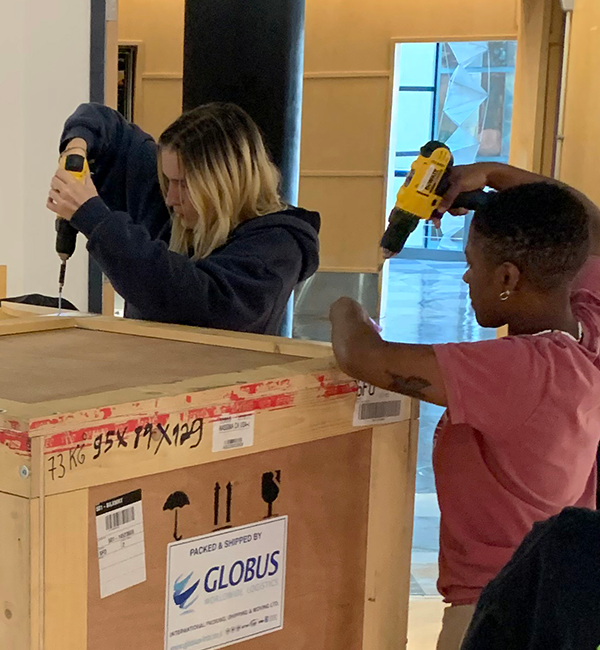
Two students drill into a 5-foot-tall wooden box while standing in the Fine Arts Gallery

Photo Credit: Adrian Morelock-Revon


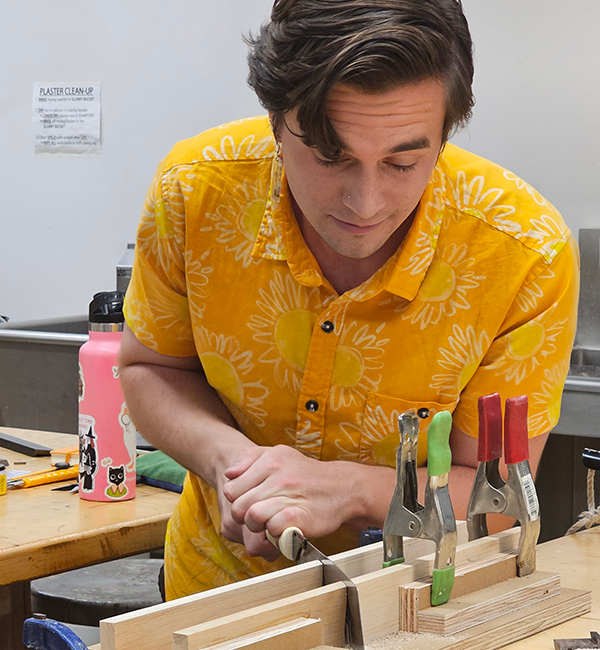
Adrian Morelock-Revon cuts into wooden blocks while standing and wearing a yellow short-sleeved collared shirt. A pink reusable water bottle decorated with stickers and a whiteboard are visible behind Morelock-Revon

Photo Credit: Ivan Jaimes-Carrillo

Student’s documentary helps her family heal from intergenerational trauma

Cecilia Mellieon and her daughter sit outdoors at Fortaleza Indian Ruins, homeland of their ancestors, near the Tohono O’odham Nation’s San Lucy Village outside of Gila Bend, Arizona. Photo from 2001.

Grad student Cecilia Mellieon utilizes visual anthropology, a field of study founded at SF State, to tell stories of urban Native American life 

With a video camera in her hands and empathy in her heart, one San Francisco State University student is focusing her capstone project on a subject many families prefer to avoid: their intergenerational trauma.  

Cecilia Mellieon, a graduate student in Anthropology at San Francisco State, is the director of a documentary titled “He told us the sky is blue.” It traces her family’s trauma to Native American oppression, focusing on the Indian boarding school her father attended in Fort Apache, Arizona.  

“If it hadn’t been for his experience there, he would have never left his family or his village,” said Mellieon, a member of the Tohono O’odham Nation. “He would have never moved to the Bay Area, and so I would not even be here if it wasn’t for him making those decisions to get away from them.” 

The U.S. government established the boarding schools to teach English and trade skills to Native American children. Violent corporal punishment occurred often.  

“The ultimate goal was to have fully assimilated second-generation children — children who were removed from their lands, children who didn’t grow up with their culture or their language or their family members,” Mellieon said. 

In her 55-minute film, Mellieon’s family recalls surviving an abusive household. They share feelings of sadness and regret as they also work to resolve their anger. 

“These are stories that I know too well, because I was there,” Mellieon said. “There are scenes where my brother and my mom are breaking down crying. I was crying with them.” 

Cecilia Mellieon headshot

Born and raised in San Francisco, Mellieon is passionate about telling stories of urban Native American life with nuance and sensitivity. She uses a supportive, collaborative approach that aims to not only create an ethnography, but also a work that will benefit the subjects. 

Her approach is an application of visual anthropology, a field of study that was founded by late SF State faculty members John Adair and John Collier. SF State Anthropology Professor Peter Biella (B.A., ’72; M.A., ’75) was one of Collier’s students, and today he is Mellieon’s adviser. 

Mellieon entered SF State as an undergraduate in 2018 at age 42. She had just completed her associate’s degree from Los Medanos College while her third child had yet to start kindergarten.  

A new Bay Area Rapid Transit (BART) extension to near her home in Antioch made the 50-mile commute to SF State feasible, with family help on child care. Now, one of her children, Tatihn Mellieon, also attends SF State, as a Creative Writing major and a student assistant in The Poetry Center. 

“It was the perfect grouping of coincidences that led to me to be able to go to State,” Cecilia Mellieon said. “If I had tried this at any other point in my life, I don’t think I would have had the life experiences. I don’t think I would have had the growth that I needed to be a confident student and be able to feel like I could tackle this.” 

Mellieon premiered “He told us the sky is blue” in November at Los Medanos College. She plans to take it to film festivals and make more anthropological films about big-city Indigenous life. 

Learn more about the Anthropology Department

SF State students write Wikipedia bios for unsung heroes of STEM

Humanities class helps fill in equity gaps among STEM professionals from underrepresented groups 

Wikipedia is among the most visited websites in the world, with information on over 6 million topics. But much is missing, particularly in diversity. Through a partnership with the user-moderated online encyclopedia, students at San Francisco State University recently wrote original biographies for notable professionals in Science, Technology, Engineering and Mathematics (STEM) from underrepresented groups. 

Scientists from traditionally underrepresented groups comprise a small minority on Wikipedia. According to Wikipedia, only about 8% of the site’s 275,000 biographies of scientists are women, with similar gaps across race and ethnicity. 

With support from the Broadcom Foundation, the Wikipedia Education group selected the San Francisco State Humanities class “History of Science from the Scientific Revolution,” taught by Associate Professor David M. Peña-Guzmán from the Department of Humanities and Comparative World Literature, as one of its partners this past summer. Wikipedia Education is a nonprofit organization that serves as the bridge between academia and Wikipedia throughout the U.S. and Canada. 

Nine of the biographies compiled by SF State students are live on Wikipedia. The students’ writing brings visibility to living professionals whose legacies have yet to be completed. They include chemical engineer Miguel Modestino, sustainable industrial engineer Enrique Lomnitz and Procter & Gamble executive and microbiologist Adrian Land. 

Maxwell Stephen Williams, a History graduate student who took the class, helped contribute the bio on Aaron Streets, a UC Berkeley bioengineering professor. Williams says the class taught him different ways to utilize Wikipedia in academic research. 

“It’s somewhat frowned upon to use Wikipedia as a source. But what’s not frowned upon, I found, was the sources that the people used for the Wikipedia article,” Williams said. “I don’t know if you should cite Wikipedia for a research paper, but it offers a general baseline. It gives you scholarly sources to further your own research.” 

Peña-Guzmán applied for the class to participate in the Wikipedia Student Program because it aligned with the themes he wanted to impart to students about the complex relationship between science and the histories of patriarchy, colonialism, classism and social bias. Writing the biographies of scientists of color who have made an impact in a scientific or technological domain was the class’ culminating project.  

“From the very beginning of the class, I built in questions about the politics of science,” he said. “Filling Wikipedia’s race gap through these biographies gave my students a very real, if minor, way of making a difference.” 

Peña-Guzmán will discuss his students’ projects on Wednesday, Dec. 13, at “Closing the gap for Black and Hispanic STEM professionals on Wikipedia,” a free virtual seminar presented by Wikipedia Education. 

The Wikipedia Student Program aims to make the broadly referenced site more inclusive and diverse. Since 2010, students from over 800 universities in the U.S. and Canada have worked on over 135,000 articles.  

“Evidence suggests that Wikipedia can influence trials in courts of law and significantly shape the world of science,” says Wikipedia Education Equity Outreach Coordinator Andrés Vera, citing two research papers led by a Massachusetts Institute of Technology faculty member. “Teaching with Wikipedia can help spread awareness about any topic to a wide audience.” 

Learn more about the Department of Humanities and Comparative World Literature


SFSU students support plant restoration in Bayview-Hunters Point

SFSU’s Climate HQ teamed up with the SF Rotary Club to transplant local native flowers in the historic San Francisco neighborhood

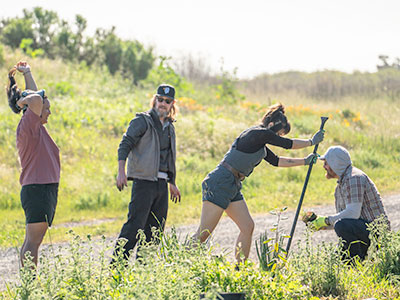
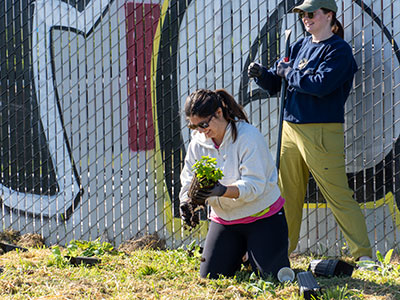
At Candlestick Point Native Plant Nursery in Bayview-Hunters Point, the view tells two very different stories. On one side is the Bay and its beauty; on the other, a decommissioned shipyard — a Superfund site with radioactive, metal and industrial contamination that continues to affect the neighborhood’s health. Hidden behind a building is a lush and lively community garden as well as the native plant nursery, both part of a nature-based response to these environmental challenges. On March 14, San Francisco State University students added their energy to the space as volunteers.

SFSU Climate HQ and the SF Rotary Club rallied 35 SFSU students, faculty and staff, community college students and Rotary members for a day of native plant restoration at the Bayview-Hunters Point nursery. The students were from across campus, representing a variety of programs like Biology, Child and Adolescent Development, Cinema, the School of the Environment and more.

“It was really nice to see a ton of people from all corners of campus coming together to do something good for the planet,” said first-year Marine Science student Sandra Chavez. Hoping for a career in conservation, she is an avid community volunteer and was excited to pitch in. 

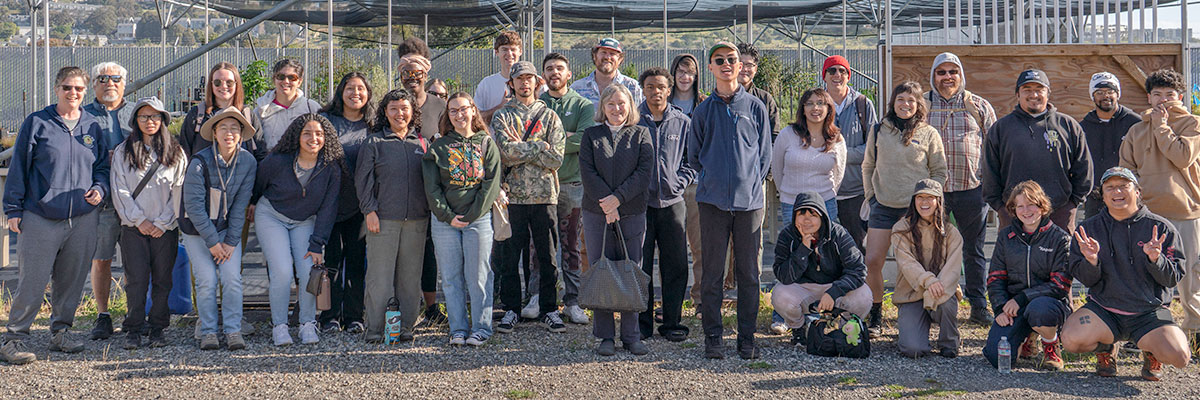
Group photo of 40 people smiling at the camera

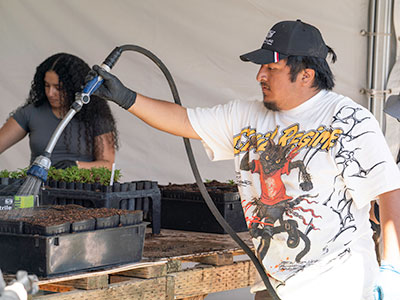
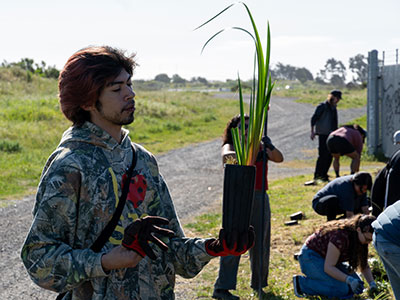
Participants spent their Saturday split into three groups to prep soil, plant, and transplant native flowers that are hardy and resistant to weather, drought and fire.

The event was spearheaded by Climate HQ Co-Director Kai Burrus, a Biology professor and Rotary Climate Action team chair. Like many in Climate HQ, Burrus uses her community connections to expand opportunities for SFSU students.

“In addition to Literacy for Environmental Justice, Climate HQ team members have relationships with people in local governments, grassroots organizations and local businesses,” she explained. Burrus says that "these connections are the fabric of our community — and the foundation for opportunities like this one." 

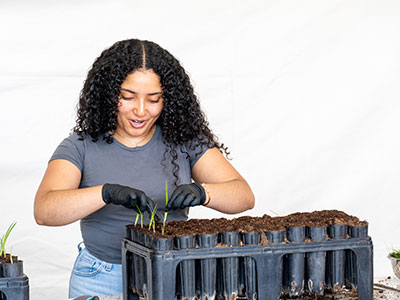
Woman planting in small black pots
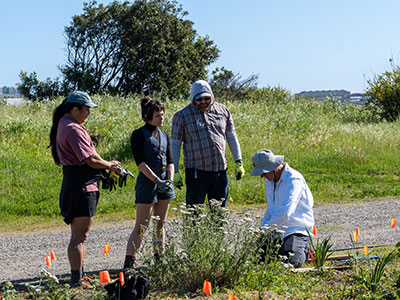
Four students gardening oustide
Four students using a large steak to prepare the ground for plans
Two students planting potted plants into the ground near a fence
Student using hose to water plans
Student holding a pot with a tall grass-like plant

Climate HQ wants to make these types of events accessible whenever possible. The goal is to help students from all majors and colleges and from any background get involved. 

“We want all students to be able to participate. Thanks to the SF Rotary Club's generous support, we were able to rent a van and bring students who otherwise couldn't have made it. Many had never been to Bayview-Hunters Point. This is about getting people out of their comfort zones and into community with others who share their values," Burrus added.

Community and hope are common themes for Climate HQ, SFSU’s campus hub that aims to centralize and support climate change and climate justice activities at the University. It offers something for everyone (students, faculty, staff and community) via classes, certificates, initiatives and events. 

“Research shows that collective action — on climate change and beyond — helps reduce the grief and anxiety so many of us are carrying. That feels deeply true to my own experience,” Burrus said.

Learn about how to become a part of SFSU Climate HQ.

Business students bring TEDx talk to SFSU

Student-organized event featured guest speakers from public, private sectors 

As the only public university in one of the world’s most forward-thinking cities, San Francisco State University is a vital nerve center for new ideas and burgeoning talent. This makes our campus a prime location for a student-organized TEDx talk, bringing over 300 people to the Student Life Events Center on Nov. 15.  

TEDx is a grassroots initiative of Technology, Entertainment, Design (TED), the distinguished nonprofit that presents live speaking events worldwide. Master of Business Administration (MBA) student Neil Sterud submitted an application for SFSU to host a TEDx talk. More than 20 additional students volunteered to help put on the event. For Sterud, organizing a TEDx event at SFSU is more than a career-building endeavor. It is a way to give back to the campus community. 

“This is hands-on project management leadership. It’s a massive, very complicated deal,” said Sterud, who also serves as a second-class petty officer for the Navy Corps of Engineers. “It’s a feather in the cap. That’s another thing that I wanted for students, and that’s what I was telling people. I said, ‘Hey, jump on with this. Help out because brands on our resume matter. If you could put on your resume that you helped with an event like this, it could help with employers, and you shouldn’t wait until you’re out of college to try to get some experience.’”  

The free event, themed “Seas of Change,” explored innovative, resilient and courageous responses to the uncharted waters in today’s society. The eight speakers spanned Bay Area nonprofit leaders as well as faculty from SFSU and the Cal Poly Maritime Academy covering topics such as addressing the housing crisis by building tiny homes, labor unions, artificial intelligence, branding, mental health and restorative justice. Magician Mike Toy (M.A., ’11) served as emcee. 

Volunteers included Liza Kucherova, a senior in Marketing who implemented a multichannel marketing campaign and created the event’s web page. MBA student Alson Cheong played recruited other student volunteers and led a team that secured RSVPs and ran the check-in table. 

“One of the main reasons I wanted to get involved is to serve our community and bring TEDx to San Francisco State. I also want to get valuable experience in event planning,” said Cheong, who serves as a Lam Family College of Business ambassador and is also studying for a Pre-Law certificate. “This experience really helped me see all the procedural steps that it takes to get an event like this done.” 

The “TEDx at SF State” was made possible in part through the support of SFSU’s Lam-Larsen Student Engagement Initiative and sponsored by SFSU’s Lam Family College of Business (LFCoB). LFCoB staff also provided behind-the-scenes support to the LFCoB student ambassadors.

“LFCoB was delighted to sponsor the event,” LFCoB Dean Eugene Sivadas said. “Our college is global in aspiration and reach, but draws its strength from the communities we serve. It was a pleasure to bring interesting and diverse viewpoints for the benefit of our students and the larger community we serve.” 

Learn more about SFSU’s Lam Family College of Business. 

Janet Wright stands next to a table with a tablecloth showing the text "TEDx SF State" while giving her talk

Janet Wright, Contra Costa County District Attorney’s Office investigator


SFSU partners with SFUSD and CCSF to guarantee admission for eligible students

The partnership ensures eligible local high school, community college students a clear path to SFSU

SAN FRANCISCO — Oct. 23, 2025 — San Francisco State University (SFSU) is finalizing a partnership agreement with the San Francisco Unified School District (SFUSD) and City College of San Francisco (CCSF) to create a guaranteed admission pathway for local high school seniors and community college students who meet eligibility requirements. The new program eliminates the uncertainty of the application process and expands opportunities for students seeking an SFSU degree. The partnership represents a major expansion of the long-running SF Promise initiative, the University’s commitment to creating educational opportunities for families in the City and County of San Francisco.

“SFUSD, CCSF, and SFSU are deeply committed to providing S.F. residents with high-quality education and access to upward mobility. Together, we fuel the workforce, innovation and success of the City and the Bay Area,” said SFSU President Lynn Mahoney. “This agreement will strengthen our commitment to San Francisco students and families by guaranteeing that higher education — and the opportunities it creates — remains within the reach of all.”

“This partnership is an incredible opportunity for our students,” said SFUSD Superintendent Maria Su. “By knowing in advance that they have a guaranteed path to SFSU, our graduates can plan with confidence and focus on their academic success.”

“We are excited to offer our graduates a guaranteed pathway to SFSU,” said CCSF Chancellor Kimberlee Messina. “This agreement provides CCSF graduates with the certainty of admission, ensuring they can continue their educational journey seamlessly and achieve their goals.”

The new initiative is part of SFSU’s ongoing efforts to remove barriers for prospective students. The University already guarantees admission for eligible military veterans and foster youth via the Guardian Scholars Program.

"For San Francisco to be a world-class city, we need a world-class education system. Our residents and families deserve that," said San Francisco Mayor Daniel Lurie. "I am proud to announce this initiative that will transform the path to higher education for thousands of San Francisco students. This program is the result of true collaboration, and I want to thank the leadership at SFUSD, City College of San Francisco and San Francisco State for coming together with one goal in mind: our students' success."

To qualify for guaranteed SFSU admission, SFUSD graduates will need to complete the required A–G high school courses with a grade of C or better and earn at least a 2.5 GPA in those courses taken in grades 10–12. Transfer students from CCSF will need to complete at least 60 transferable units with a minimum 2.0 GPA across all colleges attended and finish the “Golden Four” core courses — Oral Communication, Written Communication, Critical Thinking and Math/Quantitative Reasoning — with a grade of C- or better.

SFSU is a public university in the California State University system committed to preparing students for meaningful careers and bright futures. SFUSD is the seventh-largest school district in California, serving more than 50,000 students across the city. CCSF is one of the largest community colleges in the nation, providing affordable and accessible education to more than 40,000 students each year. Together, these three women-led institutions are strengthening access to higher education for San Francisco students.

Visit the SFSU Guaranteed Admission website for more information.

###

About San Francisco State University

San Francisco State University is a public university serving students from the San Francisco Bay Area, across California and around the world, with nationally acclaimed programs that span a broad range of disciplines. About 20,000 students enroll at the University each year, and its nearly 300,000 graduates have contributed to the economic, cultural and civic fabric of San Francisco and beyond. Through them — and more than 1,900 world-class faculty members — SF State proudly embraces its legacy of academic excellence, community engagement and commitment to social justice. For more information, visit sfsu.edu.

About SFUSD: San Francisco Unified School District is the seventh largest school district in California, educating over 50,000 students every year. San Francisco is both a city and a county; therefore, SFUSD administers both the school district and the San Francisco County Office of Education (COE). This makes SFUSD a “single district county.” Visit: www.sfusd.edu

About City College of San Francisco

Since 1935, City College of San Francisco has offered instruction opportunities, serving more than 40,000 students annually at six locations throughout San Francisco. The College offers an affordable opportunity to earn associate degrees, prepare for transfer, pursue career and technical education, and personal development and enrichment. Visit: www.ccsf.edu

Major expansion of Presidential Scholars Program launches at SFSU, honoring Maryam Mirzakhani

A gift from alumna Neda Nobari expanded the Presidential Scholars Program to specifically support STEM students’ part of the program. Pictured is the inaugural cohort.

SFSU alumna Neda Nobari’s gift expands Presidential Scholars Program to support first-gen STEM students, honoring Maryam Mirzakhani

SAN FRANCISCO – Sept. 22, 2025 – San Francisco State University (SFSU) has announced the start of a major expansion for the University’s Presidential Scholars Program (PSP), which supports first-generation, low-income students with high GPAs from the San Francisco Bay Area by covering the costs of tuition, housing, books and more for four years. This expansion creates a cohort of Maryam Mirzakhani Scholars named in honor of the late distinguished and internationally recognized mathematician Maryam Mirzakhani, who was the first woman and first Iranian to earn the prestigious Fields Medal. Iranian American businesswoman, community leader, philanthropist and alumna Neda Nobari (B.S., ’84) gave a gift to PSP to specifically support STEM students and to honor Mirzakhani’s inspiring legacy. The inaugural cohort started this fall 2025 semester. 

“Neda’s enduring commitment to San Francisco State has had a profound impact on our campus,” SFSU President Lynn Mahoney said. “We are truly thankful for her generosity, which opens doors for countless students — particularly those overcoming financial challenges as they pursue brighter futures.”

Graduating from SFSU with a Computer Science degree, Nobari has a profound passion for helping STEM students like she once was. “My hope is that these scholarships will prioritize students pursuing careers in STEM, fields close to my heart as one of the few women in my computer science cohort over 40 years ago,” Nobari said. “My goal is that these scholarships can further diversify STEM fields, benefitting students who have tremendous ability to make a difference and to honor the legacy of Professor Mirzakhani’s extraordinary accomplishments.”

About Neda Nobari

As a proud SFSU alumna and lifelong advocate for education, Nobari has a deep connection with the University and has served many roles on the SFSU Foundation Board since its inception.

“Having served as an inaugural director, chair of its investment committee and board chair during its strategic planning process, I have developed a clear understanding of the University’s priorities and the growing challenges our students face. By repurposing my endowment, I am putting our students first,” Nobari said. “SFSU is very dear to me. I spent some of my most transformative years there, and because of its impact on my life, I want to continue giving back to the University and, most importantly, to the students.”

In 2020, Nobari was named the SFSU Alumna of the Year and was inducted into the Alumni Hall of Fame. She also established in 2022 the Azar Hatefi Graduate Student Fellowship in Iranian Diaspora Studies, honoring her late mother’s legacy. 

Additionally, Nobari was pivotal in founding the Student Sustainable Investment Fund to provide students hands-on experience in sustainable investing and funding scholarships for students participating in that program. This transformational investment in PSP is also the culmination of her long trajectory of consistently supporting student fellowships and scholarships at SFSU.

About Maryam Mirzakhani

Maryam Mirzakhani was the first woman to win the prestigious Fields Medal, the highest honor in mathematics, and the first Iranian to be so honored. Admired by her peers as a brilliant and fearless scientist who took on the most challenging questions, Mirzakhani’s legacy continues to inspire generations of young women in STEM to pursue their dreams. 

While attending an all-girls high school in Tehran, Mirzakhani earned gold medals in consecutive years as the first female to compete on Iran’s International Mathematical Olympiad team. Mirzakhani went on to earn her Ph.D. in mathematics from Harvard University and spent four years as an assistant professor and Clay Mathematics Institute Research Fellow at Princeton University. During that time, she was named one of Popular Science’s “Brilliant 10” extraordinary scientists.

Mirzakhani served as a professor of mathematics at Stanford University from 2009 until her death in 2017 at the age of 40. In 2018, the International Mathematical Union, in collaboration with the Women’s Committee of the Iranian Mathematical Society, established Mirzakhani’s birthday, May 12, as International Women in Mathematics Day to celebrate her inspirational life and legacy. 

About the Presidential Scholars Program

PSP, supported by the Division of Student Life, promotes exceptional learning and adheres to the highest standards of academic quality in the spirit of inclusive excellence. Each year, scholarships are awarded based on academic merit to an entering freshman cohort. The program not only provides financial support but also fosters a sense of community among the scholars through various events and cohort-building activities. 

Founded in 1995, the program currently serves about 20 students per year, with about four to five students in each class at any given time. With the additional funds from Nobari, the program will serve 30 more students.

Learn more about the Presidential Scholars Program.